

Content atomization is the practice of breaking one large piece of content into many smaller pieces, each built to stand alone on its own channel. A small SaaS team can run it with two big ideas a week. Each idea becomes one long video, and each video becomes a newsletter, three LinkedIn posts, three X posts and a few clips. Then the numbers from each piece decide next week's ideas.
What is content atomization?
Content atomization means planning one substantial asset, such as a video, webinar or report, so it can be split into many smaller pieces. Each piece carries one idea and works on its own channel. Aprimo defines it as breaking a comprehensive piece into "smaller, independently valuable units" for different platforms and audiences (Aprimo's guide to content atomization). The big asset is the source. The small pieces do the reaching.
Atomization is close to repurposing, but the order is different. Repurposing reworks an asset after it is published. Atomization designs the asset to be split before anyone records it. That changes how the source gets made. The video gets clear segments, quotable lines and one idea per minute, because the team already knows each one will become a separate post. The record once, publish everywhere workflow covers the production side in full.
Content atomization, repurposing and modular content
Three terms get used for nearly the same thing. The table separates them.
| Term | When the splitting is planned | Unit | Best for |
|---|---|---|---|
| Content atomization | Before the source is made | One idea per piece | Social and newsletter reach from one big idea |
| Content repurposing | After the source is published | One format per piece | Getting more life out of existing assets |
| Modular content | Before, at the component level | Reusable blocks of copy and visuals | Large teams assembling pages and campaigns |
For a SaaS team, atomization is the most useful of the three. It matches how product content already gets made. A demo, a launch or a customer call is one big source that holds several separate ideas.
What does content atomization look like for a small SaaS team?
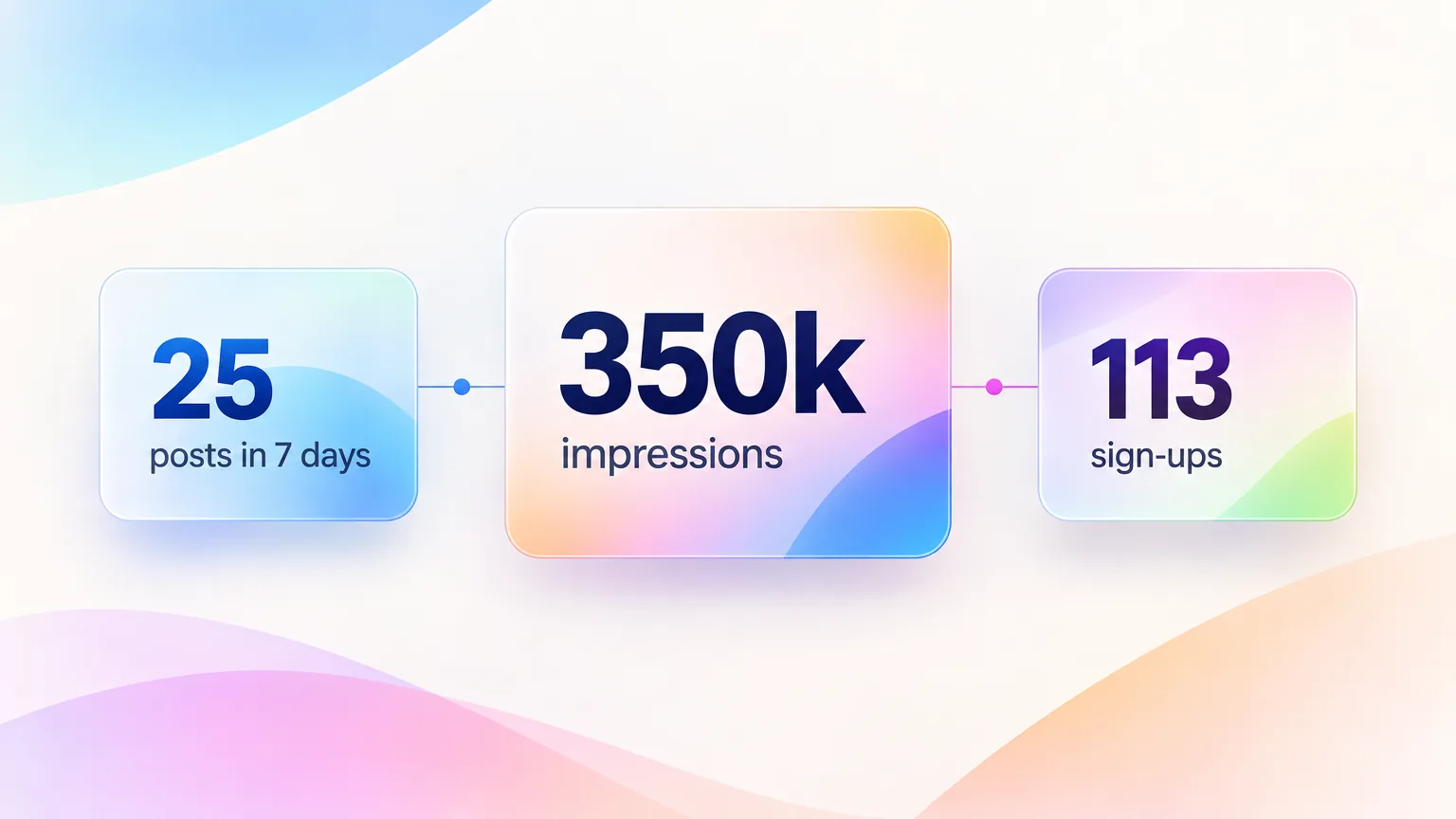
For a small SaaS team, content atomization looks like two big ideas a week turned into about twenty-five posts across four channels. One B2B SaaS founder the GuideClarity team worked with ran exactly that week. The founder published 25 posts in 7 days on LinkedIn, YouTube, X and a newsletter. It took about one full working day. The rest of the week went to customers and the product.
The founder reported these results for that week:
| Measure | Result |
|---|---|
| Big ideas | 2 |
| Posts published | 25 |
| Channels | LinkedIn, YouTube, X, newsletter |
| Time spent | About one full working day |
| Impressions | More than 350,000 |
| Sign-ups | 113 |
The founder's reason for posting that much is simple. Building software has become easy, so distribution is now the hard part to copy. A team that ships faster but posts less loses to a team that ships the same product and gets seen.
Across the founder's whole company, the same atomization approach produces around 3,500 pieces of content a week. That number covers far more than one founder's channels. The point for a small team is the ratio, not the volume. Two ideas produced 25 posts. Atomization is how a founder without a content team gets that ratio.
These are one founder's results, shared anonymously. They show what the method can do. They are not a benchmark every team should expect.
What is the content atomization framework?
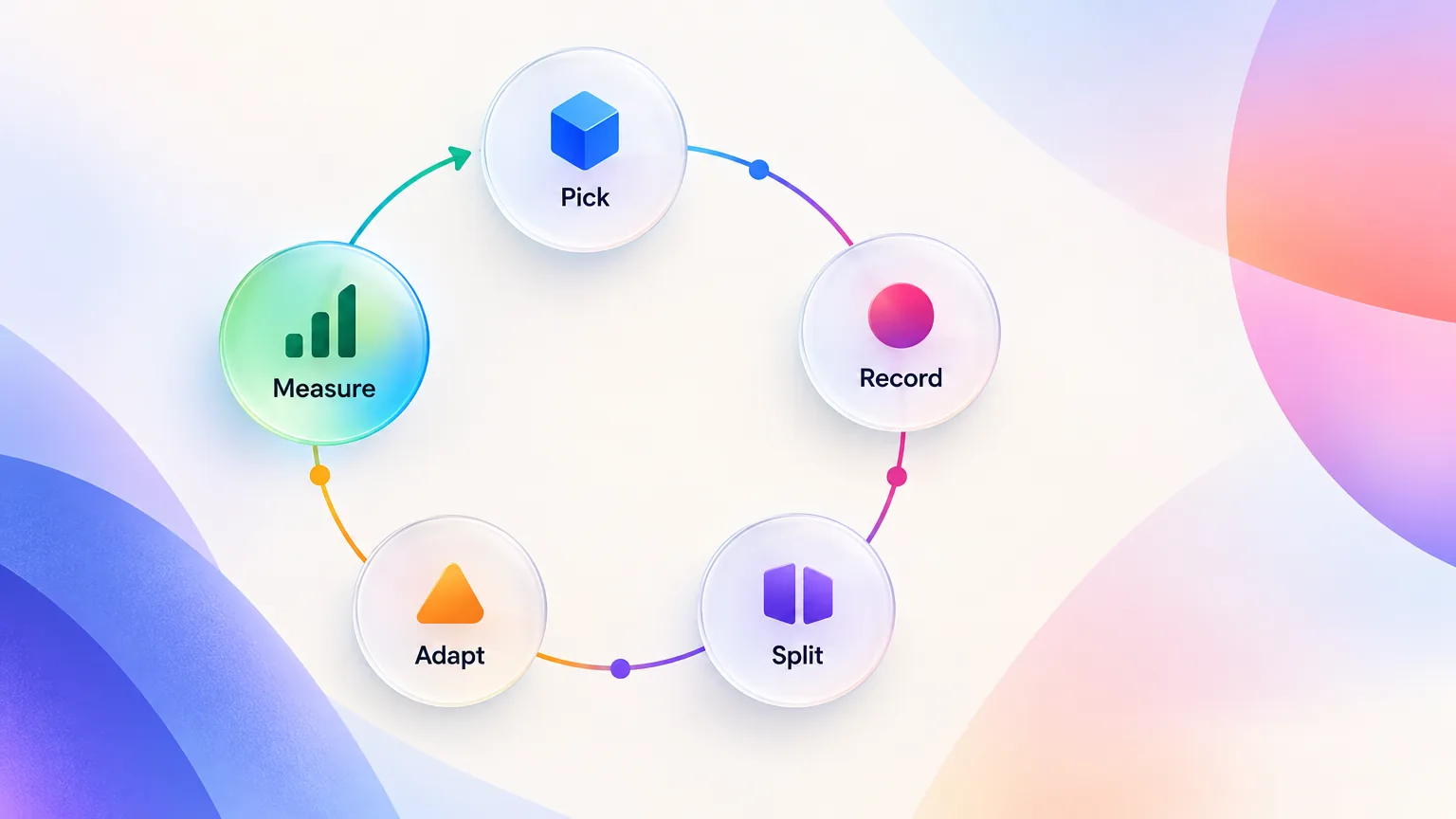
The content atomization framework is a five-stage loop. The team picks a big idea, records one long source, splits it into atoms, adapts each atom to its channel, and measures which atoms worked. The measurement then picks the next big idea. Most guides stop at distribution. The fifth stage is what turns atomization from a one-off trick into a weekly system.
Contadu and Aprimo both describe a similar five or six step workflow (Contadu's content atomization workflow). The version below is built for a small SaaS team with two ideas a week:
- Pick the big idea. Choose a topic with proof behind it, such as a customer question, a post that already outperformed, or a feature that just shipped.
- Record the source. Make one long video, 8 to 20 minutes, with one clear idea per segment.
- Split it into atoms. List every standalone point, quote, number and demo moment in the video.
- Adapt each atom to its channel. Rewrite each one for the format people use on that platform.
- Measure and choose again. Track which atoms drove impressions and sign-ups, then pick next week's ideas from the winners.
The framework is the wrong starting point for a team with no audience yet. Atomization spreads one idea across many channels, so it needs people on those channels to reach. A brand-new account gets more from one channel and one post a day until replies start coming in. Add channels once the first one shows a response.
The framework works as a content strategy framework because each stage has one owner and one output. A founder can run all five alone. A small team can split them. Either way, the source gets made twice a week and everything else comes from it.
How do you pick a big idea worth atomizing?
You pick a big idea worth atomizing by looking for proof that people already care about it. The best sources are posts that outperformed on LinkedIn, X or YouTube, questions customers ask on sales and support calls, and features that recently shipped. An idea with no proof behind it produces twenty weak posts instead of one. Atomization multiplies whatever goes in, good or bad.
The founder in the example drew ideas from two places. One was outlier posts, meaning posts in their niche that performed far above the usual level. The other was transcripts of the founder's own customer calls. Both sources show demand before any recording starts.
Use four tests before committing an idea for the week:
- Proof. Did it already get a reaction somewhere, from customers or from an audience?
- Depth. Can it fill a 10 minute video with at least six separate points?
- Showability. Can the product or a real example appear on screen?
- Fit. Does the answer lead naturally toward what the product does?
An idea that passes all four is a big idea. An idea that passes only one is a single post, and it should stay one.
The two weekly ideas should differ in type. One can be a how-to built on the product. The other can be an opinion or a lesson. That mix gives the week both search value and conversation value.
Four content atomization patterns for SaaS teams
SaaS teams have four reliable big-idea sources, and each one atomizes differently. These are the product demo, the customer conversation, the feature launch and the founder point of view. General atomization guides start from whitepapers and webinars. A SaaS team already produces these four sources as part of normal work, so the raw material costs nothing extra.
| Pattern | Source | Typical atoms | Watch out for |
|---|---|---|---|
| Demo atomization | A product walkthrough | Feature clips, a how-to post, a help article, social posts | Clips that make no sense without the full demo |
| Customer-interview atomization | A transcribed customer call | Quotes, objections answered, a problem post | Sharing anything the customer did not approve |
| Launch atomization | A feature launch video | An announcement, a changelog clip, posts over 90 days | Atoms that all say "it is live" |
| Founder-POV atomization | An opinion or lesson recorded on camera | Hot takes, a thread, a newsletter essay | Opinions with no example behind them |
Demo atomization suits product-led teams best. GuideClarity, the platform behind this blog, handles that pattern directly. It learns a shipped feature and produces a demo video, shorts, a blog post and social posts as one package (GuideClarity features). The team then adapts and schedules the atoms.
Launch atomization follows the SaaS feature launch video checklist, which plans the launch video around later cuts. Founder-POV atomization builds on founder-led content for solo founders, where one recorded opinion feeds a week of posts. A demo source starts with a good recording, covered in the guide on making a product demo video.
The content atomization map: 2 big ideas, 20+ pieces
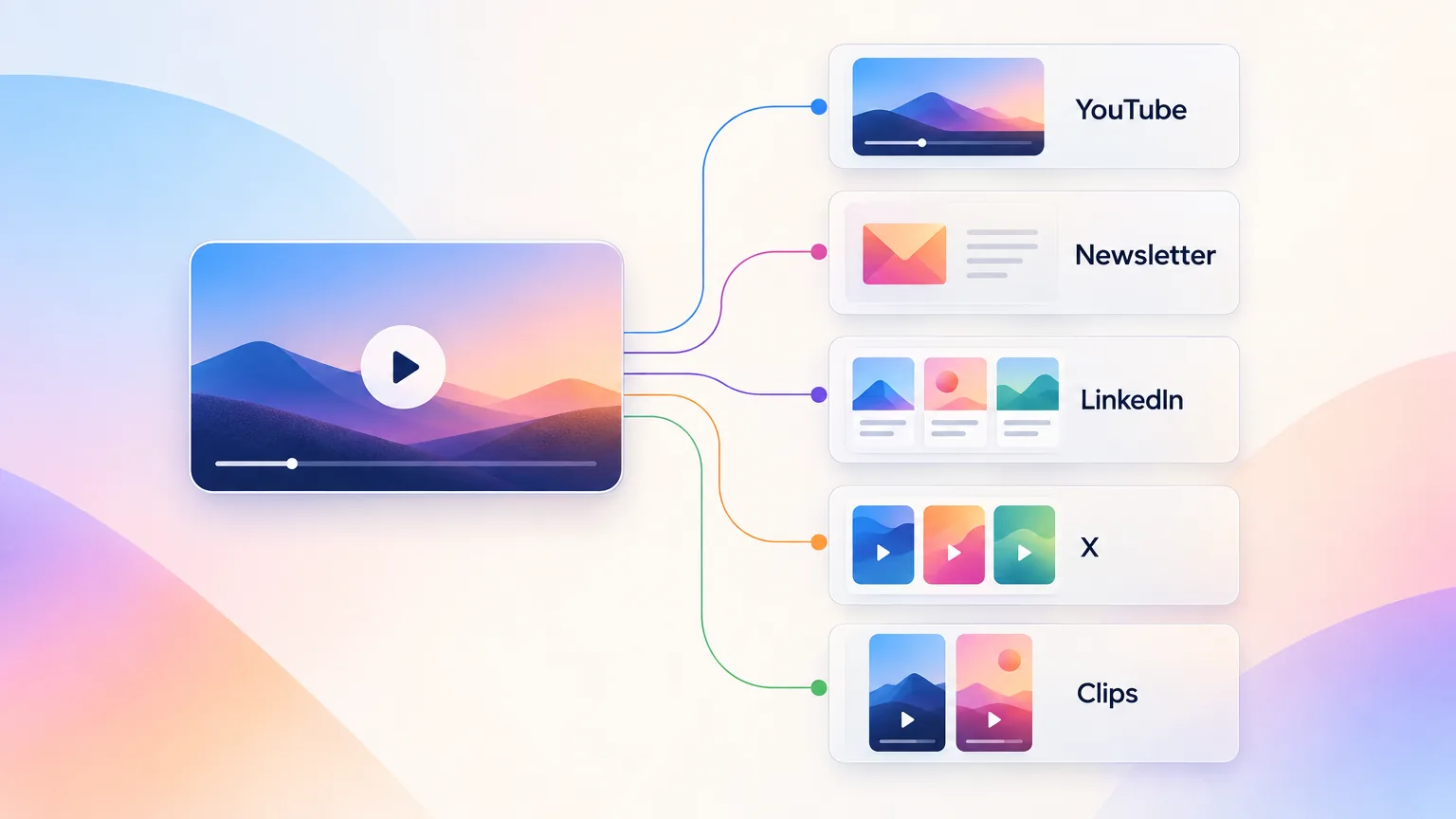
The content atomization map is the plan that says which atoms go where, and how many of each. One big idea recorded as a long video maps to about ten pieces. That is one YouTube video, one newsletter, three LinkedIn posts, three X posts and two or three short clips. Two ideas a week then produce more than twenty pieces.
This is the map per big idea, modelled on the founder's week:
| Atom | Format | Channel | Count per idea |
|---|---|---|---|
| Full argument | Long video, 8 to 20 minutes | YouTube | 1 |
| Summary plus one extra insight | Newsletter issue | 1 | |
| Single points with a hook | Text or image posts | 3 | |
| Short claims and one thread | Posts | X | 3 |
| Strongest 30 to 60 seconds | Vertical clips | Shorts, LinkedIn, Reels | 2 to 3 |
That adds up to 10 or 11 pieces per idea and 20 to 22 for two ideas. The founder's week reached 25 posts, because some atoms also became replies, reposts and follow-ups.
Here is one big idea split into atoms. The example is illustrative, written for this post. The idea is a 12 minute video called "Why our onboarding emails stopped working".
| Atom | Piece it becomes |
|---|---|
| The headline finding | LinkedIn post that opens with the result, then the three changes behind it |
| The one number that surprised the team | X post built on that number, plus a short clip of the chart |
| The old email next to the new one | LinkedIn image post comparing the two |
| The step-by-step fix | X thread with one step per post |
| The lesson the team took away | Newsletter issue with one extra example readers cannot find elsewhere |
| The best 45 seconds of the video | Vertical clip for Shorts and LinkedIn |
Spread the pieces across the week instead of posting them on one day. Publish the long video first, so every later post can point back to it. Then release one or two atoms a day. Each one reaches people who missed the others.
How do you adapt each atom for its channel?
You adapt each atom by rewriting it for how people use that channel, not by pasting the same text everywhere. A LinkedIn post needs a strong first line and white space. An X post needs one sharp claim. A newsletter needs a personal angle and one extra idea readers cannot get elsewhere. A YouTube video needs a title and thumbnail that promise one clear payoff.
| Channel | What works | What fails |
|---|---|---|
| YouTube | A specific title, a thumbnail with one idea, the answer in the first 30 seconds | A generic title, a long intro |
| A hook line, short paragraphs, one takeaway, a question at the end | A link in the post body, a wall of text | |
| X | One claim per post, a number or a contrast, threads for steps | Hashtag lists, cut-down LinkedIn copy |
| Newsletter | A personal note, the week's best point, one exclusive extra | A list of links with no point of view |
| Short clips | Captions, the strongest moment first, under 60 seconds | Clips that start mid-sentence |
A simple weekly release schedule keeps the atoms from competing with each other. This sample spreads two ideas across five days:
- Monday. Video for idea one, plus one LinkedIn post and one X post from it.
- Tuesday. A clip and a second LinkedIn post from idea one.
- Wednesday. Video for idea two, plus one LinkedIn post and one X post from it.
- Thursday. The newsletter, covering the strongest point from both ideas.
- Friday. The remaining clips, an X thread and the last LinkedIn post.
The founder in the example packaged each YouTube video with its own thumbnail and title before cutting anything else. The title became the hook for every atom that followed. One strong framing travels through the whole week.
How do you measure content atomization and choose the next big idea?
You measure content atomization by tracking results per big idea, not per post. Add up the impressions, replies and sign-ups that every atom from one idea produced. Compare the two ideas each week. The stronger idea gets a follow-up next week. The weaker one gets a new angle or gets dropped. This loop is the stage most atomization guides skip.
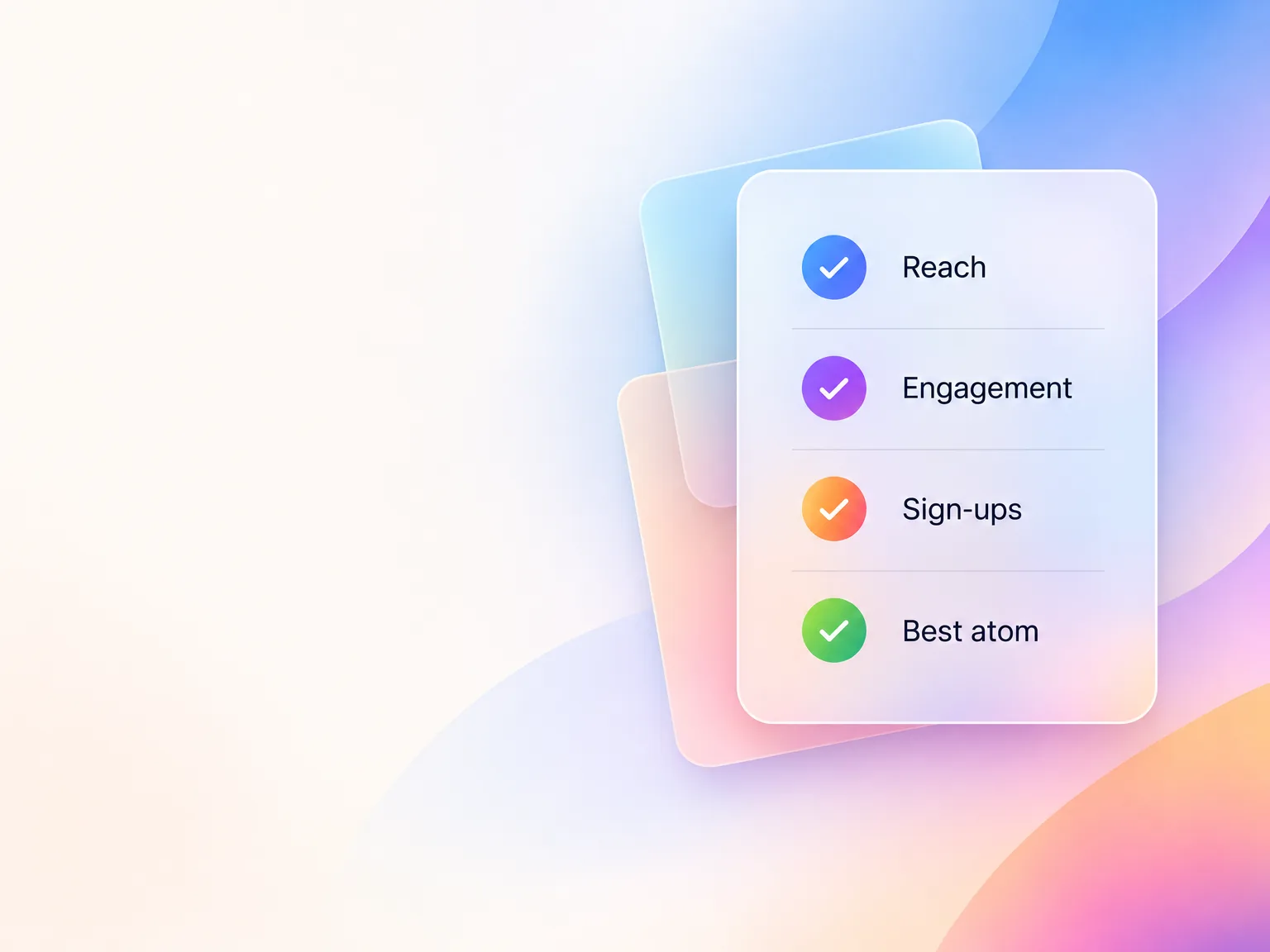
Track four numbers per big idea:
- Reach. Total impressions across every atom from that idea.
- Engagement. Comments, replies and shares, which show the idea started a conversation.
- Sign-ups or demos. The conversions that came from those atoms, tracked in the product itself.
- Best atom. The single piece that performed best, which shows the angle to reuse.
The founder in the example tracked results inside the product's own analytics, not only on the social platforms. That is how 113 sign-ups could be tied back to one week of posts. Platform metrics show attention. Product data shows whether the attention was worth anything.
A week of data is noisy, especially for a small audience. Judge a type of idea over three or four weeks before dropping it. Keep a simple log of each big idea, its atoms and its four numbers. After a month, the log shows which kinds of ideas your audience rewards.
What mistakes break content atomization?
Six mistakes break content atomization for SaaS teams. Teams atomize weak ideas, paste the same copy everywhere and publish everything on one day. They also skip measurement, let AI rewrites flatten the voice, and treat atomization as a one-off campaign. Each one wastes the effort that went into the big idea. Most of them come from rushing the split instead of planning it.
- Atomizing a weak idea. Twenty posts from an idea nobody cares about is twenty times the noise. Use the four tests before recording.
- Copy-paste distribution. The same text on LinkedIn and X reads as spam on at least one of them. Rewrite each atom.
- One-day dumps. Posting all the pieces at once lets them compete with each other. Spread them over the week.
- No measurement. Without per-idea numbers, the team keeps guessing what to make next.
- Flat AI rewrites. AI drafts are a fast start, but every atom needs a human pass to keep the voice and the specifics.
- One-off campaigns. Atomization pays off as a weekly habit. A single big push followed by silence loses the audience it built.
The fix for all six is the same loop. Pick ideas with proof, plan the atoms before recording, adapt each one, spread them out, and let the numbers choose the next ideas. For how this fits into a wider content plan, the guide to SaaS content marketing covers the bigger picture.
Key Takeaways
- Content atomization plans one big source so it splits into many standalone pieces, which is different from reworking content after it is published.
- Two big ideas a week can produce more than twenty pieces across YouTube, a newsletter, LinkedIn, X and short clips.
- One B2B SaaS founder published 25 posts in 7 days from two ideas, in about one day of work. The founder reported more than 350,000 impressions and 113 sign-ups.
- Pick big ideas with proof behind them, such as outlier posts, customer-call questions or new features.
- Rewrite every atom for its channel and spread the pieces across the week.
- Measure results per big idea, in your own product data, and let the winners choose next week's ideas.
Frequently Asked Questions
What is content atomization?
Content atomization is breaking one large piece of content into many smaller pieces that each stand alone on a different channel. A long video, webinar or report becomes social posts, clips, a newsletter and articles. The key difference from repurposing is planning. The source is designed to be split before it is made, so every atom carries one clear idea.
What is the difference between content atomization and repurposing?
Content atomization is planned before the source exists, while repurposing happens after an asset is already published. Atomization shapes the recording so it splits cleanly into separate ideas. Repurposing takes a finished asset and converts it into new formats. Many teams do both, atomizing new sources and repurposing their older best performers.
How many pieces of content can you get from one idea?
One strong idea recorded as a long video usually produces 10 to 12 pieces. That is one video, one newsletter, three LinkedIn posts, three X posts and two or three short clips. Replies, reposts and follow-ups can add a few more. Two ideas a week therefore produce more than twenty pieces.
How long does content atomization take each week?
Content atomization for two big ideas a week can fit into about one full working day. That covers recording both videos, writing the atoms and scheduling them. One B2B SaaS founder published 25 posts in 7 days on that budget. Teams that use AI drafting and a scheduler spend most of that time on review rather than writing.
What are the benefits of content atomization?
The benefits of content atomization are more reach from the same effort, a consistent message across channels, and better data on which ideas work. Each big idea gets tested in many formats at once. The team learns faster what its audience responds to, and every new piece costs a fraction of the original recording.
Do small SaaS teams need special tools for content atomization?
Small SaaS teams need four kinds of tools for content atomization. These are a way to record the source, a way to transcribe and draft atoms, a way to cut short clips, and a scheduler. Analytics inside the product matter too, because they show which ideas brought sign-ups rather than just impressions.
What to Read Next
If you want the full workflow behind atomization:
- Record once, publish everywhere workflow, the H6 workflow this framework builds on.
If you are choosing your big-idea sources:
- Founder-led content for solo founders, the founder point-of-view pattern in depth.
- SaaS feature launch video checklist, planning a launch video for later cuts.
If you are planning the bigger picture:
- What is SaaS content marketing, how atomization fits a full content program.