TL;DR
Storylane vs Navattic comes down to budget and demo format. Storylane is better for teams starting small, because its Starter plan publishes unlimited demos for far less than Navattic's first paid plan, and it adds sales rooms. Navattic is better for teams that want HTML demos and CRM integrations from the first paid plan. At the higher tiers, the two are close.
- Pick Storylane if you want to start cheaply with screenshot demos and grow into HTML demos, sales rooms and an AI SDR.
- Pick Navattic if your marketing team wants HTML demos, five seats and a Salesforce or Marketo integration from day one.
- Pick GuideClarity if you want product demo videos and explainer videos generated from your live SaaS product, plus the docs, shorts and blog post, rather than a clickable tour.
Storylane vs Navattic at a glance
The table compares Storylane and Navattic on the points buyers check first. Starting price is the cheapest paid plan in US dollars a month, at the yearly or annual billing both pages open on. A tinted cell marks the side with the edge. We read every price and limit on each vendor's own page on September 27, 2026.
| Criterion | Storylane | Navattic |
|---|---|---|
| Best for | A cheap start, sales rooms and an AI SDR | HTML demos for marketing teams |
| Starting price | $40 a month, yearly | $500 a month, billed annually |
| Free plan | 1 seat, 1 published demo | 1 seat, 1 demo that can be HTML |
| HTML demos from | Growth at $500 a month | Base, the first paid plan |
| Sandbox demos from | Enterprise | Growth |
| Sales rooms and AI SDR | Hubs and RepX | Navattic Agents, priced separately |
| Salesforce integration from | Premium at $1200 a month | Base |
| SSO from | Premium | Growth |
| Biggest limitation | HTML and Salesforce sit on higher plans | A high entry price for one or two users |
How we compared Storylane and Navattic
Storylane and Navattic both turn your product into an interactive demo that buyers click through. We compared them on the six things buyers argue about in reviews and search questions. Those are price, demo formats, AI, sales features, integrations and security. Both vendors' own pricing and home pages are the only sources for facts.
- Own screenshots. Every homepage and pricing screenshot on this page is ours, taken on September 27, 2026 at 1440 pixels wide.
- Verified facts. Every price, limit and plan detail comes from the vendor's own page, and a script re-checked each one on September 27, 2026. Navattic draws its prices as graphics, so we read those from our screenshot.
- An edge on every criterion. Each section ends with the side that wins it and the one fact that decides it. A tie is called when the answer depends on the team.
- No affiliate links. No vendor on this page pays us for a mention or a click.
GuideClarity publishes this page. It is not one of the two tools compared. Where it fits and where it does not is stated in its own section, with the same directness as the strengths and weaknesses of Storylane and Navattic.
What Storylane and Navattic are
Storylane in brief
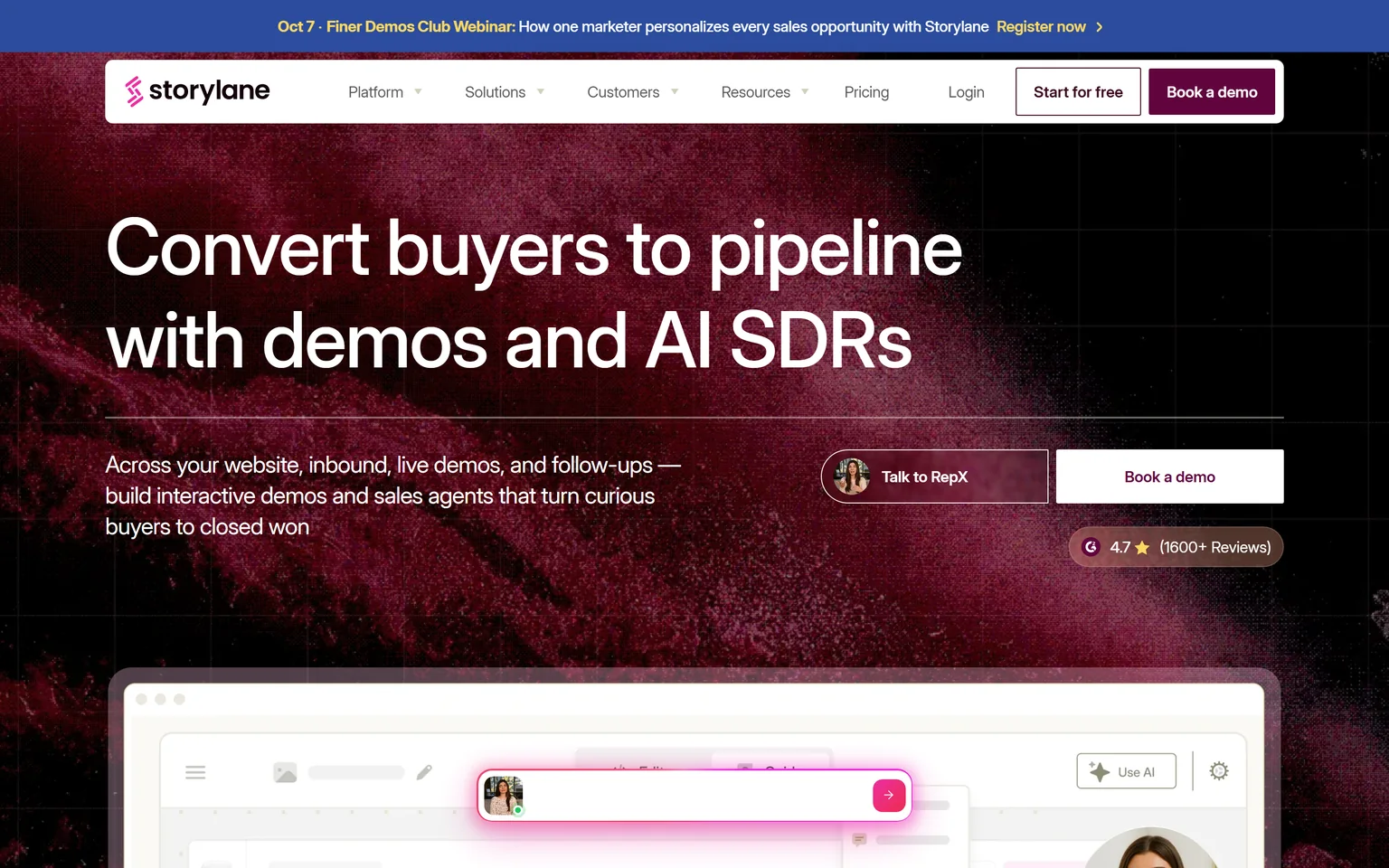
Storylane builds interactive demos and AI SDRs that convert buyers to pipeline. It captures screenshots, video or HTML into guided demos, then adds Hubs for sales rooms and RepX, an AI agent for your website. Product marketers and sales teams buy it, from a single founder on the free plan to large revenue teams.
Navattic in brief
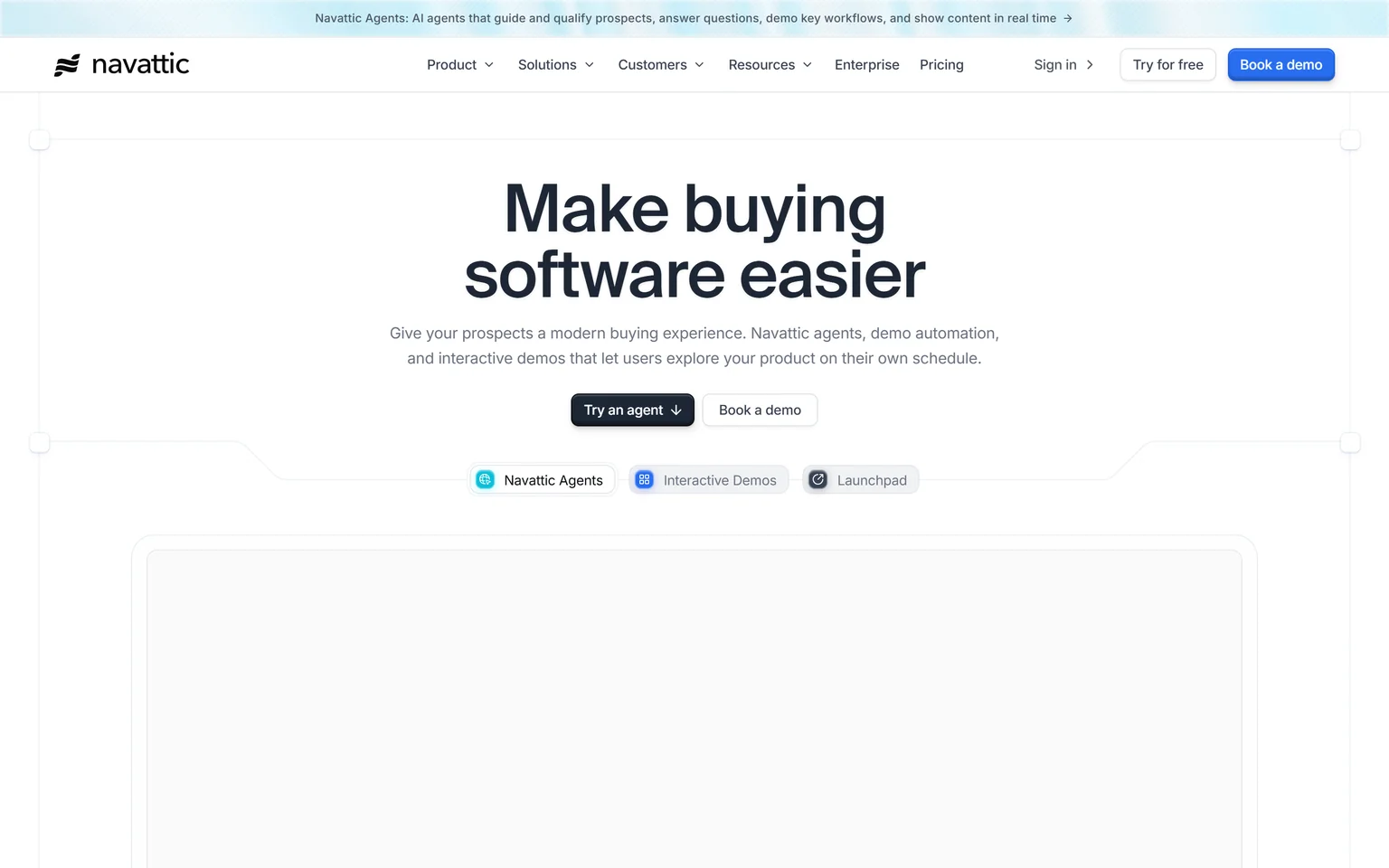
Navattic offers AI agents, demo automation and interactive demos. It captures your product as HTML, so text and data can be edited after capture, and its Copilot drafts demos for you. It targets marketing teams that run website tours and ads, and sales teams through Launchpad. Its homepage shows 4.8 stars from 1,095+ reviews.
Storylane vs Navattic pricing
Storylane wins on price for most teams. Storylane Starter costs $40 a month with yearly billing and includes unlimited published demos. Navattic's first paid plan, Base, shows $500 a month billed annually. At that level the two meet. Storylane Growth also costs $500 a month, with five seats, like Navattic Base.
Storylane pricing
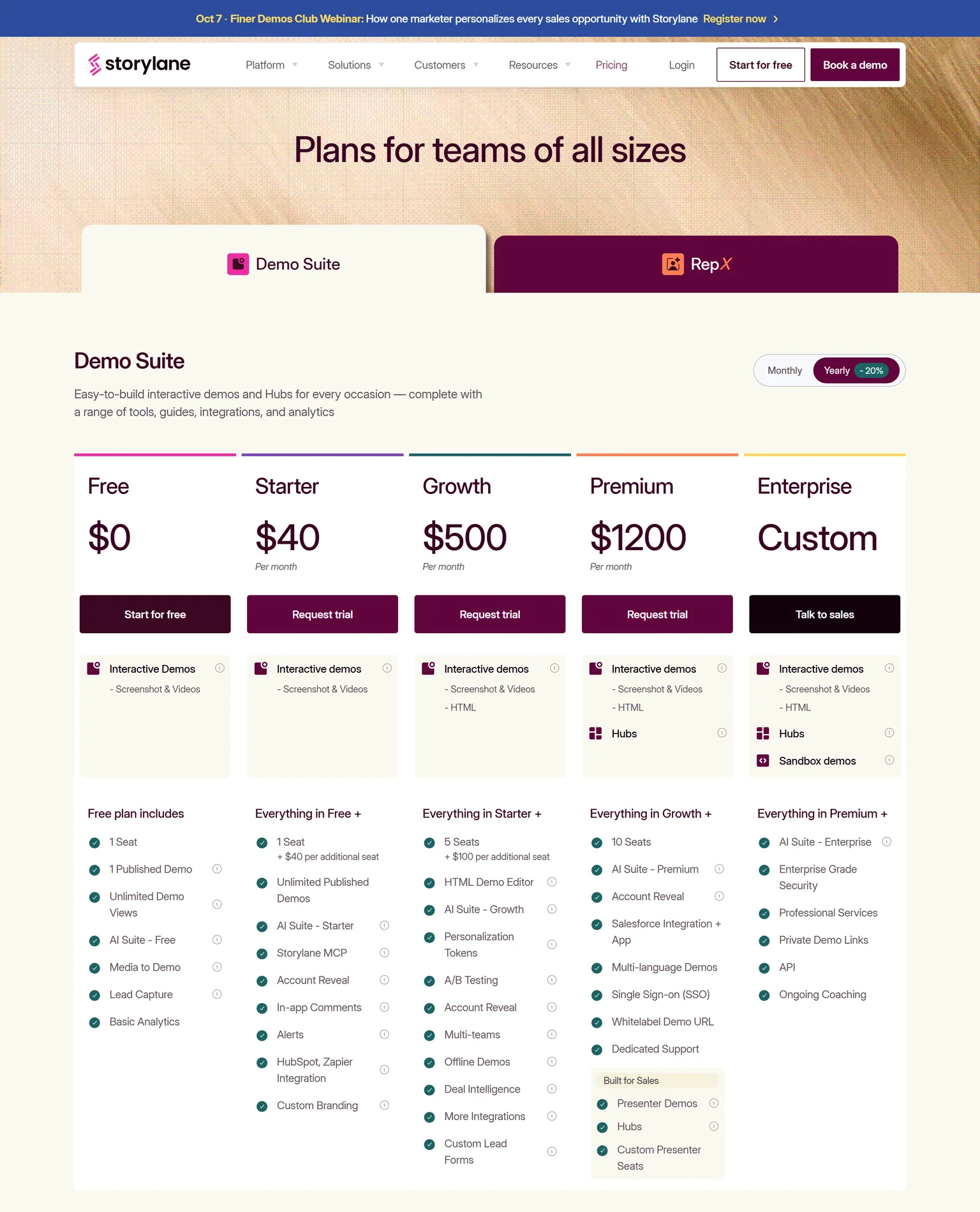
The Free plan costs $0 with 1 seat and 1 published demo. Starter costs $40 a month with yearly billing, plus $40 per additional seat, or $50 a month with monthly billing. Growth costs $500 a month with yearly billing and includes 5 seats. Premium costs $1200 a month and includes 10 seats. Enterprise is custom priced.
Navattic pricing
The Starter plan is free for everyone with 1 seat and 1 demo, HTML or media. The page shows prices as graphics, so we read them from our screenshot. Base shows $500 a month billed annually, and Growth shows $1,000 a month billed annually. A startup plan for teams of 30 or fewer is priced on request.
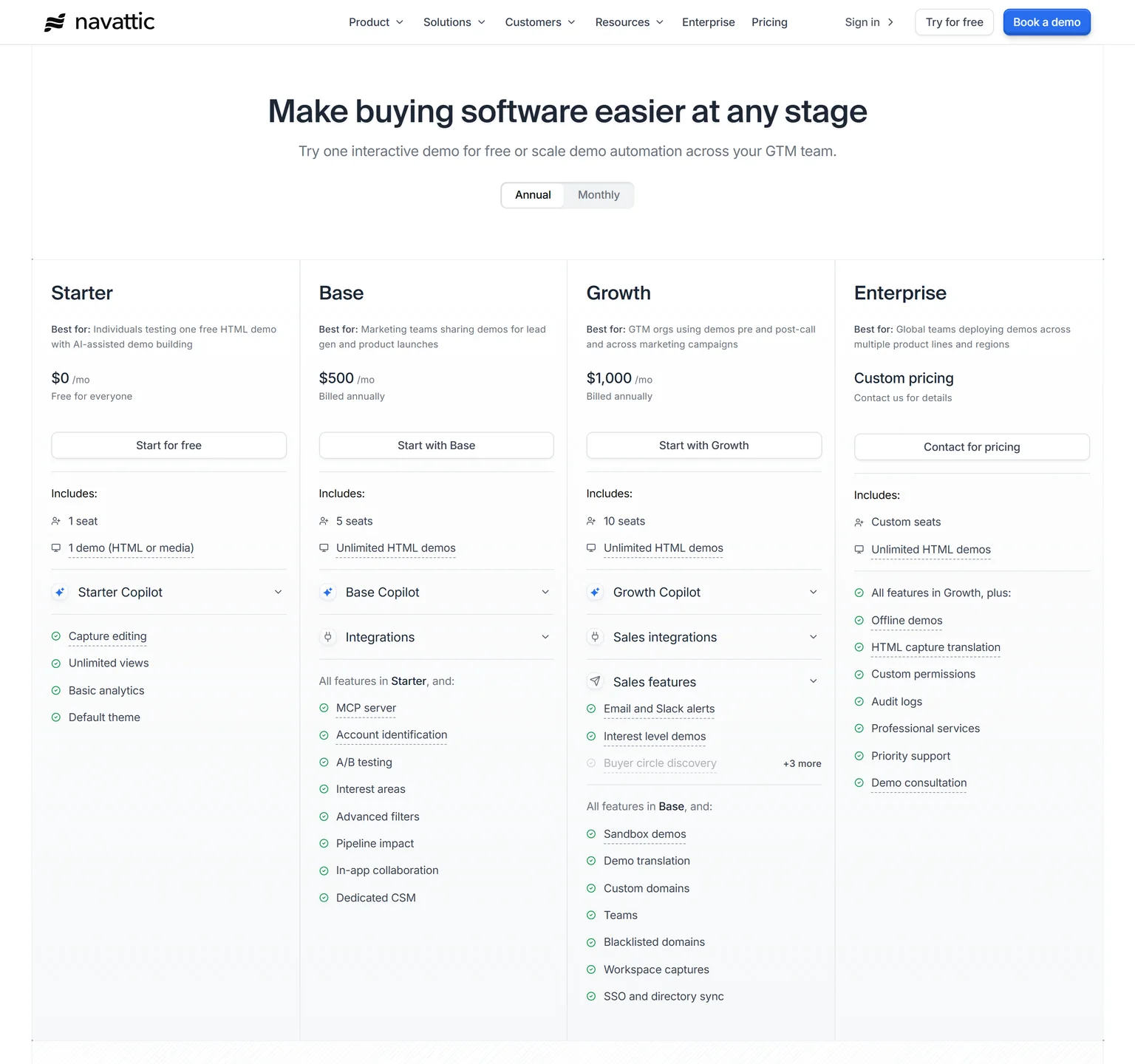
What the same money buys
One person who needs a handful of screenshot demos pays far less on Storylane Starter. A team of five that wants HTML demos pays the same list price on either tool. At ten seats, Navattic Growth lists less than Storylane Premium. Early-stage teams should ask Navattic about its startup plan before comparing list prices.
Edge Storylane, because its $40 Starter plan publishes unlimited demos, while Navattic's first paid plan shows $500 a month.
Storylane vs Navattic demo formats
Navattic wins on demo formats. HTML capture sits at the heart of its product. Its free demo can be HTML, and Base includes 5 seats and unlimited HTML demos. Storylane starts with screenshots and video, and its HTML demo editor arrives on Growth. Sandbox demos follow the same pattern. Navattic adds them on Growth, while Storylane adds them on Enterprise.
Why HTML matters
An HTML demo copies the page code, not a picture of it. You can change text, numbers and names after capture, and the demo looks sharp on any screen. That lets a marketer personalize a demo per account without recapturing it. Screenshot demos are faster to build, but every change means a new capture.
Capture and export
Storylane's plan comparison lists capture from a Chrome extension, a desktop app for Mac and Windows, and a Figma plugin. It also lists exports as GIF, video and PDF, which helps when a demo must live in an email or a deck.
Edge Navattic, because HTML demos come on every plan and sandbox demos arrive a tier earlier than on Storylane.
Storylane vs Navattic AI and agents
AI is a tie, because both now sell a demo builder and a buyer-facing agent. Storylane's RepX greets website visitors, handles product questions and books qualified meetings. Navattic's agents do similar work, and they are priced on the number of conversations and agents. Both add AI voiceovers and avatars to demos.
Building demos with AI
Navattic's Copilot drafts a demo from your screens and suggests edits. Base adds premium AI voiceovers and 100 minutes of AI avatars, and Growth 300 minutes. Storylane bundles an AI suite on every plan, with more on higher tiers, and lets you prompt a demo into shape. For most teams, the draft quality will matter more than the feature list, so test both on your own product.
Agents for buyers
RepX and Navattic Agents both answer questions and show the right demo in real time. RepX is sold as its own product on Storylane's pricing page. Navattic Agents come with access to the Base plan.
Edge Tie, because both offer an AI demo builder and a buyer-facing agent, sold alongside the demo plans.
Storylane vs Navattic sales features
Storylane wins on sales features. A Storylane Hub is a digital sales room your champion can forward, with demos, pricing and security documents in one link. Premium adds presenter demos for live calls. Navattic serves sales through Launchpad, and Growth adds sales integrations with Gong, Salesloft and Outreach. Storylane gives a seller more ways to run the deal inside one tool.
How a deal runs in each
On Storylane, a seller shares a Hub after the first call. The buying group explores demos, reads documents and asks RepX questions, and the seller sees who engaged. On Navattic, the seller sends demos and playbooks, and alerts show who is interested. Both track engagement. Storylane packages it as a room, and Navattic as demos plus signals.
Edge Storylane, because Hubs give the buying group one forwardable room with demos and documents.
Storylane vs Navattic integrations
Navattic wins on integrations for teams that run on Salesforce or Marketo. Navattic Base includes integrations with Salesforce, Marketo and 25+ more, plus A/B testing. On Storylane, Starter includes a HubSpot and Zapier integration, while the Salesforce integration and app arrive on Premium. A HubSpot team is well served by Storylane at a much lower price.
Testing and personalization
Both support A/B tests. Storylane Growth adds personalization tokens, A/B testing and offline demos, so the same demo can greet each account by name. Navattic's HTML capture makes the same kind of personalization natural. Our guide on making a SaaS demo video that converts covers when an interactive demo beats a video.
Edge Navattic, because Salesforce and Marketo come on its first paid plan, while Storylane holds Salesforce for Premium.
Storylane vs Navattic security
Security is a tie. Navattic reaches single sign-on sooner, because Growth adds SSO and directory sync. Enterprise adds audit logs, offline demos and HTML capture translation. Storylane puts single sign-on on Premium, one tier higher. It also states more on its pricing page, where the plan comparison lists SOC2 Type II, GDPR and SSO (SAML).
What this means for buyers
A team that needs SSO at ten seats pays less on Navattic Growth. A security reviewer who asks for a SOC2 report sees it named on Storylane's pricing page. Ask Navattic for its own compliance reports if your review requires them.
Edge Tie, because Navattic reaches SSO on a cheaper plan, while Storylane states SOC2 Type II on its pricing page.
Storylane vs Navattic: which should you choose
Choose by your first year. If you are starting with a few demos and a small budget, Storylane wins, because its Starter plan costs a fraction of Navattic's first paid plan. If you want HTML demos and Salesforce from day one, Navattic wins at the same price as Storylane Growth. At ten seats and up, the decision turns on sales rooms versus sandbox demos.
Storylane strengths and weaknesses
Strengths
- A low-priced Starter plan with unlimited published demos.
- Hubs for sales rooms and RepX as an AI SDR.
- Exports as GIF, video and PDF.
- SOC2 Type II named on the pricing page.
Weaknesses
- HTML demos start on Growth.
- Salesforce and SSO wait for Premium.
- Sandbox demos only on Enterprise.
Navattic strengths and weaknesses
Strengths
- HTML demos on every plan, even the free one.
- Salesforce and Marketo on the first paid plan.
- Sandbox demos and SSO on Growth.
- A startup plan for small early-stage teams.
Weaknesses
- A high entry price for one or two users.
- Prices are shown only as graphics on the pricing page.
- No sales room like Storylane's Hubs.
- If you are one person or a small team starting out, pick Storylane. Starter publishes unlimited demos for little money.
- If your marketing team wants HTML demos and runs on Salesforce or Marketo, pick Navattic.
- If your sellers need a room to share with a buying group, pick Storylane for Hubs.
- If you need sandbox demos without an enterprise contract, pick Navattic Growth.
- If you want cheaper demo tools than both, see our Supademo alternatives and Arcade alternatives pages, or our Storylane vs Supademo comparison.
- If you ship SaaS features and want the launch videos and content generated from the product, pick GuideClarity.
Where GuideClarity fits between Storylane and Navattic
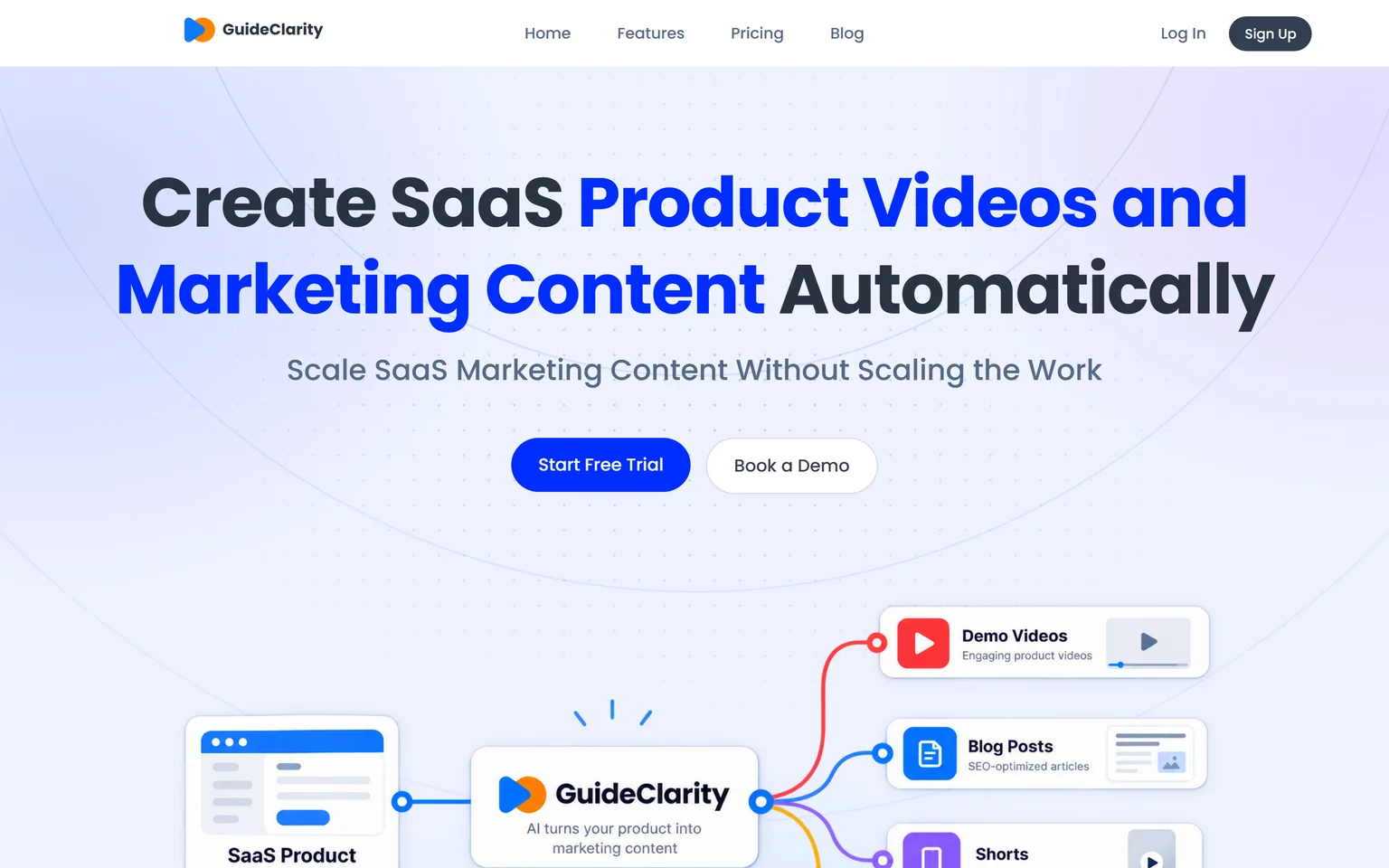
Storylane and Navattic build clickable demos that buyers explore. GuideClarity builds the videos and launch content around a feature instead. It generates the product demo video and the explainer video from the live product, then the docs, shorts, blog post and social posts. It suits SaaS teams that ship often and need content for every channel. Teams whose buyers must click through the product should pick Storylane or Navattic.
GuideClarity pricing
The free plan includes 3 video guide recordings with AI voiceover and 6 marketing videos. Pro costs $59 a month billed monthly, or $49 a month billed annually. Business costs $99 a month. Every paid plan carries a 14-day money-back guarantee.
Strengths
- Builds the product demo video and explainer video from the product.
- One feature in, a whole launch kit out, with shorts, docs and a blog post.
- Video plays anywhere, including email, social feeds and YouTube.
- A free plan to test on a real feature.
Weaknesses
- Not a clickable demo builder. Hands-on tours belong in Storylane or Navattic.
- Built for SaaS product content, not for sales rooms or buyer agents.
GuideClarity vs Storylane and Navattic
GuideClarity creates SaaS product videos and marketing content automatically. It turns one release into a demo video, a short, a blog post, social posts, screenshots and a release announcement. A clickable demo on the pricing page and a video everywhere else work well together. The GuideClarity features page lists every output. Our SaaS demo software buyers guide explains when each format wins.
Frequently asked questions about Storylane vs Navattic
Is Navattic better than Storylane?
Navattic is better when you want HTML demos and Salesforce from the first paid plan, since Base includes unlimited HTML demos and Salesforce and Marketo. Storylane is better for a cheap start, since Starter costs $40 a month with yearly billing, and for sales rooms. So in Navattic vs Storylane, the budget and the demo format decide.
Is Navattic free?
Navattic has a free plan. The Starter plan is free for everyone with 1 seat and 1 demo, HTML or media. That is enough to test one real demo on your site. Paid plans start with Base, which shows $500 a month billed annually. Early-stage teams of 30 or fewer can ask for a startup plan.
What are the pricing options for Navattic?
Navattic lists four plans. Starter is free. Base shows $500 a month and Growth shows $1,000 a month, both billed annually. Enterprise is custom priced. Navattic Agents are priced on the number of conversations and agents. Growth includes 10 seats, sandbox demos and SSO.
What are some free alternatives to Storylane?
Storylane itself has a free plan with 1 seat and 1 published demo. Navattic's free Starter plan allows 1 demo that can be HTML. For more free demos, our Supademo alternatives page compares tools with larger free plans on verified prices.
What is the best interactive demo software?
It depends on the job. Storylane suits teams that start small and want sales rooms. Navattic suits marketing teams that want HTML demos and CRM data. Cheaper tools such as Supademo and Arcade fit single creators. If your buyers would rather watch than click, GuideClarity generates product demo videos from your product instead.
How did you verify the prices on this page?
We opened each vendor's pricing page in a browser on September 27, 2026 and saved its text. A script then checked every quoted price and limit against that saved page. Navattic draws its prices as graphics, so we read them from our own screenshot. Both pages opened on yearly or annual billing, and we quote those prices.
Sources and verification
Every fact above was read on the pages below on September 27, 2026. The vendor's own page wins over any third-party listing when they disagree. Prices change, so check the vendor before you buy.
- Storylane pricing page, checked September 27, 2026.
- Storylane homepage, checked September 27, 2026.
- Navattic pricing page, checked September 27, 2026.
- Navattic homepage, checked September 27, 2026.
- GuideClarity pricing page, checked September 27, 2026.
- GuideClarity homepage, checked September 27, 2026.
Need product videos to sit next to your interactive demos? GuideClarity generates the demo video, the explainer video, the shorts, the blog post and the social posts from your live product.
The free plan includes 3 video guide recordings with AI voiceover, so you can run a real feature through it before paying.