
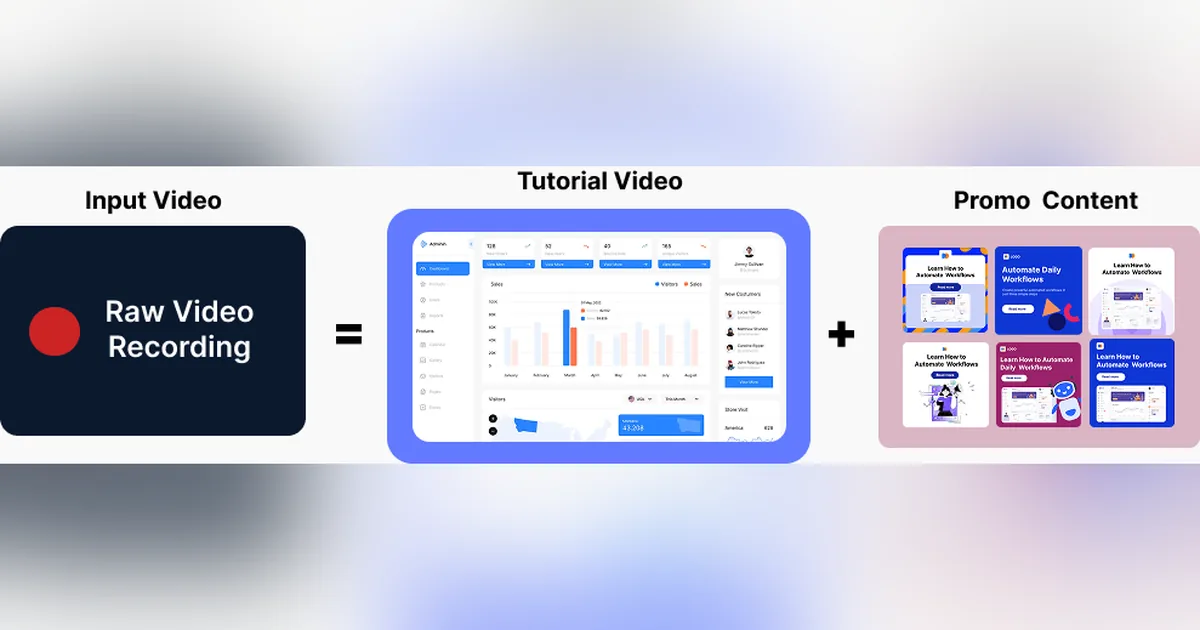
AI content creation for SaaS is transforming how teams produce marketing materials, product documentation, and customer communications. Instead of spending weeks writing, you can generate high-quality content in hours while maintaining your brand voice and accuracy.
This guide shows you exactly how to implement AI content creation for your SaaS business. You'll learn practical strategies that increase output without sacrificing quality. If you're building a broader SaaS content marketing strategy, this AI implementation guide will help you scale your content production effectively.
Why SaaS Companies Are Adopting AI Content Creation
SaaS companies face unique content challenges. You need to explain complex features simply, create multiple content types, and maintain consistency across channels.
Traditional content creation takes time. A single blog post might require 10-15 hours of research, writing, and editing. AI tools cut this to 2-3 hours while handling repetitive tasks.
Here's what makes AI content creation valuable for SaaS:
- Produces content 3-5x faster than manual writing
- Maintains consistent tone across all materials
- Scales documentation as your product evolves
- Reduces hiring costs for junior content writers
- Handles routine updates automatically
The key advantage? Your team focuses on strategy while AI handles execution.
Choose the Right AI Content Tools for Your Needs
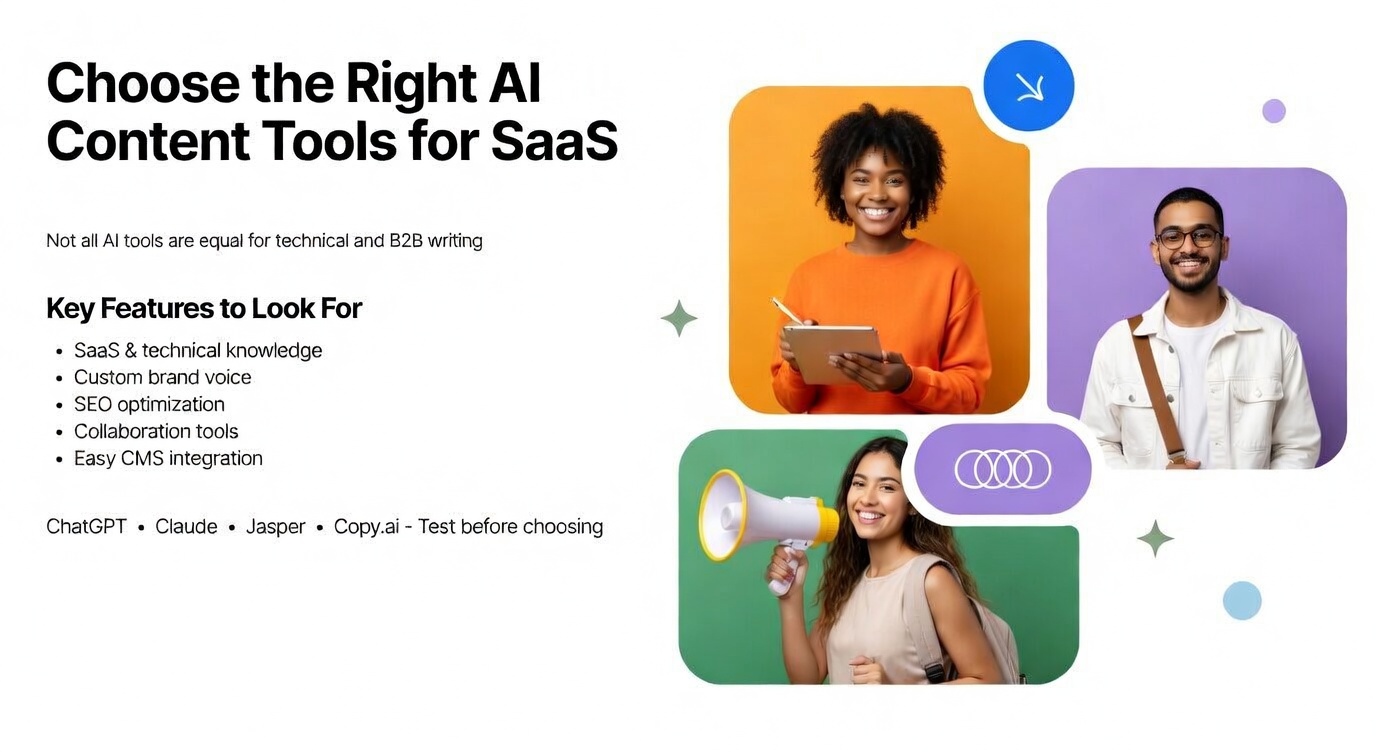
Not all AI writing tools work equally for SaaS content. You need tools designed for technical writing, not general marketing copy.
What to Look for in AI Content Tools
The best AI content creation tools for SaaS have specific features:
- Industry knowledge: Tools trained on SaaS, technical, and B2B content
- Customizable templates: Formats for blog posts, product pages, and documentation
- Brand voice settings: Options to match your company's tone and style
- SEO optimization: Built-in keyword research and meta tag generation
- Collaboration features: Team editing and approval workflows
- API access: Integration with your existing content management system
Popular options include ChatGPT Plus, Claude, Copy.ai, and Jasper. Each excels in different areas, so test several before committing.
Comparing Tool Capabilities
Different tools serve different purposes. ChatGPT excels at long-form content and brainstorming. Jasper specializes in marketing copy and SEO optimization. Claude handles technical documentation better than most alternatives.
Start with a free trial before paying. Most tools offer 7-14 day trials that let you test real workflows.
Create a Content Framework for AI Generation
Raw AI output rarely works without guidance. You need a clear framework that tells AI exactly what to produce.
Build a Detailed Content Brief
The best AI content starts with the best instructions. Your content brief should include:
- Define your target audience (job title, experience level, pain points)
- State the primary goal (educate, persuade, convert, inform)
- Specify the format (blog post, case study, email sequence, documentation)
- List required sections and word count for each
- Include brand voice guidelines and tone examples
- Provide 2-3 competitor examples you want to match or exceed
- Add any technical requirements or specific information to include
The more detailed your brief, the better your AI output. Vague instructions produce vague content.
Establish Your Brand Voice in AI Systems
AI tools can learn your brand voice through examples. Feed the system 3-5 pieces of your best content and explain what makes them work.
Create a voice guide document covering:
- Sentence length preferences (short, medium, or varied)
- Technical depth (beginner-friendly vs. advanced)
- Personality traits (friendly, authoritative, casual, formal)
- Common phrases you use and phrases to avoid
- Industry terminology you prefer
Reference this guide every time you prompt AI. Consistency improves dramatically with clear standards.
Master the Art of Effective AI Prompts
Your prompts determine your results. A weak prompt produces weak content. A strong prompt produces publication-ready material.
Structure Prompts for Better Output
Follow this proven prompt structure:
- Role: "You are a SaaS marketing expert specializing in [your niche]"
- Task: "Write a blog post about [specific topic]"
- Audience: "Target audience is [job title] who [pain point]"
- Format: "Use this structure: introduction, 3 main sections, FAQ, conclusion"
- Tone: "Match this voice: [example of your writing]"
- Requirements: "Include [specific data], [number] examples, [keyword naturally]"
- Length: "Aim for [word count]"
This structure eliminates ambiguity. AI knows exactly what you want.
Iterate and Refine Content
First drafts are starting points, not final products. Use follow-up prompts to improve:
- "Make this more conversational and less corporate"
- "Add specific statistics and real examples"
- "Shorten sentences to under 18 words each"
- "Emphasize the customer benefit, not the feature"
- "Rewrite the introduction to hook readers immediately"
Three rounds of refinement typically produce publication-ready content.
Optimize AI-Generated Content for Search Engines
AI content creation for SaaS must rank in search results. Raw AI output often misses SEO best practices.
Integrate Keywords Naturally
Tell AI about your target keywords before generation. Include them in your prompt:
"Write this article targeting the keyword 'AI content creation for SaaS.' Include related terms like 'automated content generation,' 'AI writing tools,' and 'content automation platforms' naturally throughout. Aim for a keyword density of 0.8-1.2% without forcing keywords into awkward sentences."
AI respects these instructions better than you might expect. Review the output to ensure keywords feel natural, not forced.
Structure Content for Featured Snippets
Featured snippets drive significant traffic. AI can help you target them with proper formatting.
Ask AI to include:
- A clear answer to the main question in the first paragraph
- Numbered lists for step-by-step processes
- Definition paragraphs for "what is" questions
- Comparison tables for product evaluations
- Short summary paragraphs (40-60 words) that answer specific queries
This structure helps Google select your content for featured snippets, increasing visibility.
Use AI for Different Content Types
AI content creation for SaaS works best when tailored to specific formats. Different content types require different approaches.
Blog Posts and Educational Content
AI excels at blog posts. Give it your target keyword and audience, and it generates comprehensive guides quickly.
Best practices for AI blog generation:
- Specify the blog post length (1,500-2,500 words is ideal for ranking)
- Request an engaging introduction that answers the question immediately
- Ask for specific examples from your industry
- Include a call-to-action that matches your business goals
Edit for accuracy and add your unique insights. AI provides the structure; you provide the authority.
Product Documentation and Help Articles
AI handles technical documentation surprisingly well. It can transform feature specifications into clear user guides.
For documentation, prompt AI to:
- Explain features in beginner-friendly language
- Include step-by-step screenshots captions
- Add troubleshooting sections for common issues
- Use consistent formatting and terminology
Documentation is ideal for AI because it's rule-based and repetitive. Let AI handle the heavy lifting while you verify accuracy.
Email Campaigns and Marketing Copy
AI generates compelling email subject lines and body copy. It understands persuasion psychology and can match your voice.
For email campaigns, request:
- 5-10 subject line variations with A/B testing recommendations
- Email body copy that leads with benefits, not features
- A clear, specific call-to-action button
- Multiple versions for different audience segments
Test AI-generated emails against your best performers. Most teams find AI versions match or exceed human-written versions.
Implement Quality Control and Fact-Checking
AI content creation for SaaS requires human oversight. AI can hallucinate facts, misrepresent data, or contradict your product specifications.
Build a Review Checklist
Every piece of AI-generated content needs review. Use this checklist:
- Verify all statistics and data points against original sources
- Check that product features are accurately described
- Confirm competitor information is current and correct
- Review tone and voice consistency with brand guidelines
- Test all links and ensure they're not broken
- Scan for outdated information or deprecated features
- Check for plagiarism using a plagiarism detector
- Proofread for grammar and spelling errors
This process takes 15-20 minutes per piece. It's non-negotiable for maintaining credibility.
Create a Fact-Checking Workflow
Assign one person to verify claims before publishing. They should:
- Check industry statistics against original sources
- Verify product claims with your product team
- Confirm competitor information is accurate
- Test any instructions or processes described
This prevents embarrassing errors that damage credibility. One mistake can undermine an entire piece of content.
Scale Content Production Without Losing Quality
AI's real power is scaling. You can produce 10x more content without 10x more writers.
Build a Content Production System
Create a repeatable process for high-volume content:
- Build a content calendar for 90 days
- Batch create briefs for all planned content
- Generate all AI drafts in one session
- Assign review and editing tasks to team members
- Schedule publication across your channels
This system lets one person manage output that would require three traditional writers.
Automate Routine Content Updates
Some content needs regular updates. Use AI to automate this process:
- Pricing pages: AI can update pricing tables and comparison sections automatically
- Feature lists: When you release features, AI generates descriptions matching your style
- Case studies: AI can template case study generation for faster production
- FAQ sections: Support teams feed common questions to AI for instant FAQ content
This frees your team from repetitive writing tasks. Focus on strategy instead.
Measure Content Performance and Optimize
Not all AI-generated content performs equally. Track metrics to identify what works.
Key Metrics to Monitor
Measure these metrics for every piece of content:
- Search rankings: Track keyword positions weekly
- Organic traffic: Monitor clicks and impressions from search
- Engagement: Track time on page, bounce rate, and scroll depth
- Conversions: Measure leads or sales generated from each piece
- Shares: Monitor social shares and backlinks
Use Google Analytics, Search Console, and your CRM to gather this data. Let metrics guide your content strategy.
Refine Your AI Content Strategy
After 30 days of data, identify patterns:
- Which topics generate the most traffic?
- What content length performs best?
- Which formats convert visitors to leads?
- What tone resonates with your audience?
Feed these insights back to your AI prompts. Tell AI what's working and request more of it.
Common Mistakes to Avoid
Even experienced teams make mistakes with AI content creation for SaaS. Learn from common pitfalls.
Publishing Without Editing
Raw AI output often contains errors. Never publish without human review. Mistakes damage credibility and rankings.
Ignoring Your Brand Voice
Generic AI content sounds like generic AI content. Invest time in teaching AI your voice. The effort pays dividends in every piece you generate.
Treating AI as a Complete Solution
AI is a tool, not a replacement for strategy. You still need to research topics, understand your audience, and define goals. AI executes your vision; it doesn't create it.
Forgetting SEO Fundamentals
AI doesn't automatically optimize for search. You must provide SEO requirements in your prompts. Include target keywords, desired length, and search intent.
Not Updating Old Content
AI-generated content becomes outdated like any content. Schedule quarterly reviews and updates. Use AI to refresh old pieces with current information.
Real-World Examples of AI Content Success
Here's how SaaS companies are using AI content creation effectively:
Example 1: Documentation at Scale
A project management SaaS company generated 200+ help articles in 6 weeks using AI. Instead of hiring three writers, they used one writer to review AI output. Result: 40% increase in support tickets resolved without contacting support.
Example 2: Blog Growth
A marketing automation platform increased blog publishing from 2 posts monthly to 2 posts weekly using AI. Their organic traffic grew 65% in 6 months. AI handled first drafts; their team focused on strategy and optimization.
Example 3: Email Campaigns
A CRM company used AI to generate 50 email variations for their nurture sequence. AI-generated emails achieved 18% open rates versus 12% for manually written emails. The AI understood persuasion psychology better than their team expected.
These examples show AI's potential when implemented strategically. Learn more about building a complete content marketing strategy for SaaS growth.
Getting Started With AI Content Creation Today
You don't need to overhaul your entire content operation. Start small and expand.
Your First 30 Days
- Choose one AI tool and sign up for a free trial
- Document your brand voice with 5 example pieces
- Create one detailed content brief
- Generate your first piece of content
- Edit and publish following your review checklist
- Track performance for 30 days
- Refine your process based on results
This approach lets you learn without major investment. Most teams see results within 30 days.
Scaling to Your Team
Once you've proven results, expand to your team:
- Train team members on your AI tools and processes
- Create shared brand voice guidelines
- Build a content calendar and assignment system
- Establish review workflows and approval processes
- Schedule regular strategy meetings to optimize results
Scale gradually. Each team member should generate 5-10 pieces before managing their own workflow.
Quick reference guide comparing popular AI writing tools across key capabilities for SaaS content creation.
| Tool Name | Best For | Key Strength | Best Feature |
|---|---|---|---|
| ChatGPT Plus | Long-form content and brainstorming | Versatile and conversational | Extended context window |
| Jasper | Marketing copy and SEO | Marketing-focused templates | Built-in SEO optimization |
| Claude | Technical documentation | Handles complex technical topics | Superior accuracy and reasoning |
| Copy.ai | Quick marketing materials | Fast generation | Multiple content format templates |
| General AI Tools | Budget-conscious teams | Lower cost entry point | Free tier availability |
Comparison of time investment required for different content types with and without AI assistance.
| Content Type | Manual Time | AI-Assisted Time | Time Saved |
|---|---|---|---|
| Blog post (1,500 words) | 10-15 hours | 2-3 hours | 70-85% |
| Product documentation | 8-12 hours | 1-2 hours | 75-90% |
| Email campaign series | 6-8 hours | 1-2 hours | 75-85% |
| Social media content (1 week) | 4-6 hours | 30-45 minutes | 85-92% |
| Landing page copy | 5-7 hours | 45-60 minutes | 85-90% |
Frequently Asked Questions
What is the best AI tool for SaaS content creation?
The best tool depends on your needs. ChatGPT excels at long-form content and brainstorming. Jasper specializes in marketing copy and SEO. Claude handles technical documentation. Start with free trials to test which matches your workflow.
How much time does AI content creation actually save?
AI typically reduces content creation time by 60-70%. A 2,000-word blog post takes 10-15 hours manually but 3-4 hours with AI (including editing and optimization). Email copy takes 2 hours manually but 30 minutes with AI.
Can AI-generated content rank in Google?
Yes, if it's high-quality and optimized for SEO. Google cares about helpful, relevant content, not whether humans or AI wrote it. AI content ranks well when it provides genuine value and follows SEO best practices. Just remember that AI search is redefining what "ranking" even means — our 2026 SaaS SEO survival guide breaks down how to stay visible in ChatGPT and Google AI Overviews.
How do I maintain my brand voice with AI content?
Provide AI with detailed voice guidelines and examples. Include your tone preferences, common phrases, and style preferences in every prompt. Review and edit initial outputs to establish patterns. AI learns and improves with feedback.
Is AI-generated content considered plagiarism?
No, AI-generated content is original. However, always verify facts and avoid copying competitor content. Use plagiarism checkers on all output. Provide proper citations for any data or quotes you include.
How often should I update AI-generated content?
Review content quarterly for outdated information. Update statistics, product features, and competitor information annually. Set calendar reminders for evergreen content review. Use AI to refresh old pieces with current information.
Conclusion
AI content creation for SaaS is no longer optional. It's becoming the standard for teams that want to scale efficiently.
Start with one tool and one content type. Master the process, measure results, and expand gradually. Within 90 days, you'll produce significantly more content without proportionally increasing costs.
Ready to implement AI content creation? Choose one AI tool today, create your first brief, and generate your first piece of content.