
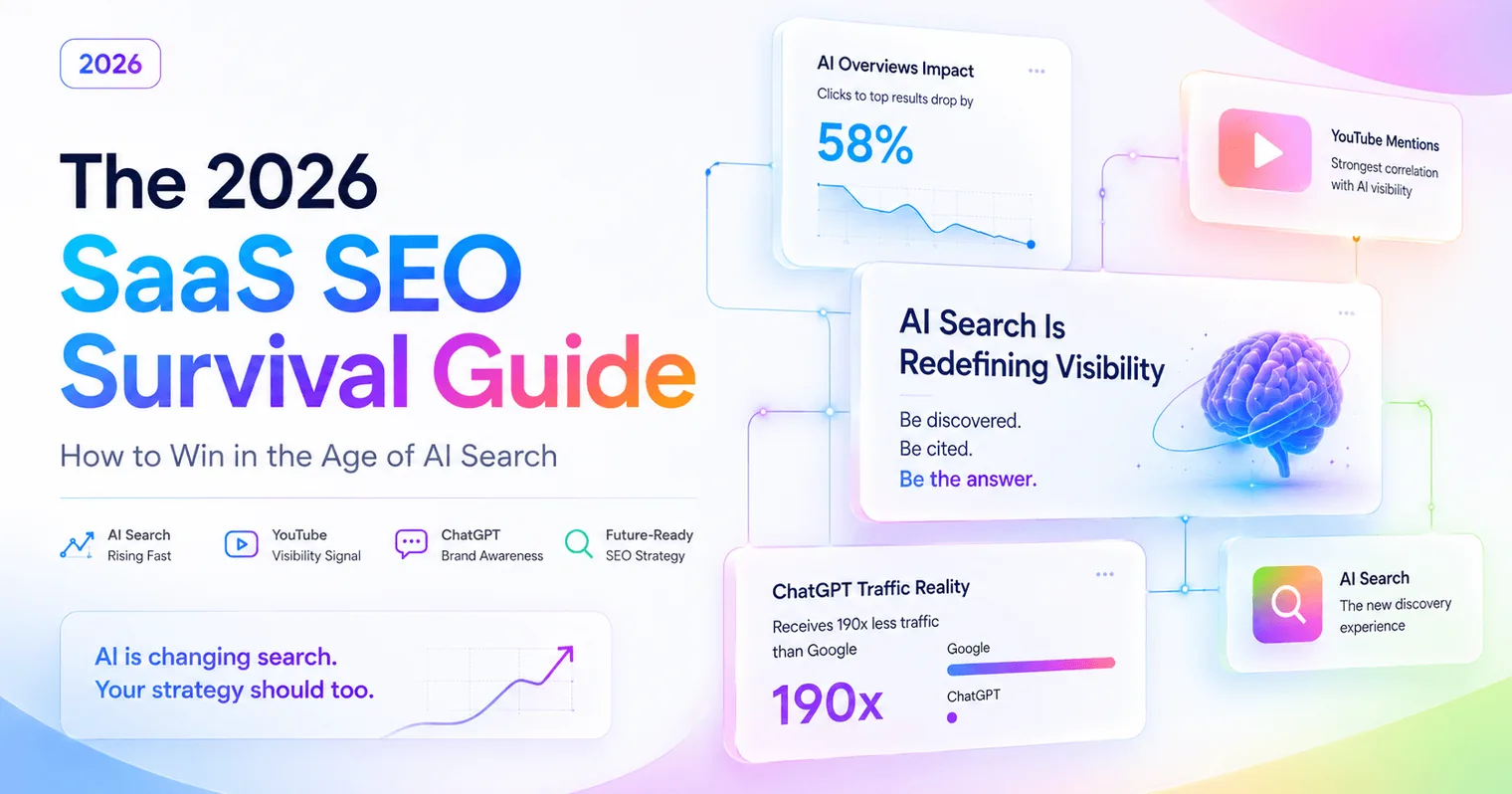
SaaS SEO is being fundamentally reshaped by AI search in 2026. Google AI Overviews and ChatGPT increasingly answer user questions directly, reducing clicks to traditional search results. SaaS companies now need to optimize not only for rankings, but also for AI citations, brand visibility, YouTube presence, and conversational search discoverability.
For years, SaaS growth teams had a simple playbook: rank on Google, drive traffic, and convert visitors into trials. That playbook is breaking.
In 2026, users are no longer just searching. They are asking AI systems directly:
- ChatGPT
- Google AI Overviews
- Gemini
- Perplexity
- Claude
And increasingly, those systems answer questions without sending users to your website at all. The result? Many SaaS companies are seeing declining organic clicks even when rankings stay stable.
The companies winning today are not just optimizing for Google rankings anymore. They are optimizing for AI visibility, citations, brand authority, and multi-platform discoverability.
A new benchmark report from Ahrefs analyzing AI search behavior across hundreds of thousands of queries confirms this shift, and the data reveals a completely different future for SaaS marketing. Let's break down what changed — and how smart SaaS teams are adapting.
Organic Traffic Is Shrinking Faster Than Most Teams Realize
One of the biggest findings from the report is brutal: Google AI Overviews reduce clicks to top-ranking pages by up to 58%. Even if your article ranks #1, users may never click it. Instead, Google extracts information from your content and displays the answer directly inside AI-generated summaries.
The impact affects nearly the entire first page:
| Ranking Position | Click Reduction |
|---|---|
| #1 | -58% |
| #2 | -50.8% |
| #3 | -46.4% |
| #10 | -19.4% |
This changes everything about top-of-funnel SaaS content. For years, many SaaS businesses relied heavily on informational search traffic, such as "best CRM software," "how to onboard SaaS users," or "project management workflow examples." Now AI systems answer many of those queries instantly, and users often never leave the search result page.
What This Means for SaaS Teams
Traffic alone is becoming a weaker KPI. The real goal now is becoming:
- the cited source
- the trusted authority
- the brand AI systems repeatedly reference
Visibility is no longer only about clicks. It is about influence inside AI-generated conversations.
YouTube Became One of the Strongest AI Ranking Signals
This was one of the most surprising findings in the report. Across 75,000 brands, YouTube mentions correlated more strongly with AI visibility than backlinks, domain authority, or even branded search volume. That is a massive shift.
For years, SaaS SEO strategies were heavily text-focused: blogs, landing pages, comparison pages, and backlinks. But AI systems increasingly learn from multimodal sources — especially video.
Why This Matters
AI models appear to treat YouTube as a high-trust knowledge source. That means product demos, educational explainers, walkthroughs, founder interviews, tutorials, reviews, and industry discussions all contribute to AI discoverability.
In practical terms, a SaaS brand consistently mentioned across YouTube may gain stronger visibility inside:
- ChatGPT responses
- Google AI Overviews
- Gemini citations
- AI-generated recommendations
The Smart SaaS Strategy
Modern SaaS teams should stop treating YouTube as "just another content channel." Instead, it should become part of the core growth engine. The highest-performing companies in 2026 are building systems that continuously turn product knowledge into explainer videos and other formats:
- Shorts
- Tutorials
- Explainer videos
- Webinars
- Social clips
- Documentation videos
- Customer education content
Video is no longer optional brand content. It is becoming part of SEO itself.
ChatGPT Is Huge — But It Still Sends Almost No Traffic
There is a dangerous misconception spreading across startup communities: "Google is dead. ChatGPT will replace websites." The actual data says otherwise.
Google still sends roughly 190x more traffic to websites than ChatGPT. That number surprises many founders. Even though ChatGPT usage exploded, AI assistants behave differently from search engines: their goal is to keep users inside the conversation, not send them away.
The New Reality
AI platforms are incredible for brand awareness, authority building, product discovery, and perception shaping. But they are still weak referral engines. This creates a major strategic shift:
- Traditional SEO goal: get clicks.
- AI search goal: become part of the answer.
Those are very different optimization models.
The Best Performing SaaS Content Looks Different in 2026
One of the most useful insights from the report is understanding what type of content AI systems actually cite. And honestly? It is not what most SaaS blogs are producing.
"Best X" Content Dominates AI Citations
The strongest-performing pages were not giant 4,000-word "ultimate guides." Instead, AI systems heavily cited comparison lists, curated software recommendations, practical tool roundups, and structured recommendation content. Our own SaaS demo software buyer's guide is one example of this highly citable format. Other examples include:
- Best Product Analytics Tools
- Best CRM for Startups
- Best QA Management Platforms
- Best AI Video Tools for SaaS
This type of content works because AI systems prefer structured comparisons, clear categorization, concise summaries, and easy extraction.
Long Content Matters Less Than Clarity
For years, SaaS SEO teams were told: "longer content ranks better." That assumption is collapsing. The report found almost no correlation between word count and AI citations, and many highly cited pages were under 1,000 words.
What mattered instead was clarity, structure, freshness, and direct answers.
The New Content Formula
Winning content in 2026 tends to have:
- clear headings
- fast answers
- scannable sections
- practical examples
- strong formatting
- continuously updated information
This is especially important because AI systems increasingly prefer content that feels current and reliable. The fundamentals of SaaS content marketing still apply — they just have to be executed faster and with tighter structure.
Freshness Is Becoming Critical
One statistic stood out immediately: nearly 90% of pages cited by ChatGPT had been updated recently. AI systems heavily prioritize fresh information, especially in SaaS, where products evolve weekly, pricing changes constantly, features update rapidly, and integrations appear overnight.
Old content decays much faster now.
The Winning SaaS Workflow
The best SaaS marketing teams are no longer publishing static blogs. They are building continuous content systems that monitor industry changes, refresh existing articles, update screenshots, revise comparisons, expand FAQs, and republish strategically. Many of them lean on AI content creation tools to keep this maintenance loop running at scale.
Content maintenance is becoming as important as content creation.
Brand Narrative Control Is Now an SEO Requirement
One of the more concerning findings in the report involves AI hallucinations. Researchers discovered that AI systems sometimes trusted Reddit, Quora, Medium, and third-party discussions more than official company websites. This creates a real problem for SaaS brands: if inaccurate information spreads online, AI systems may repeat it.
What Smart Companies Are Doing
Leading SaaS teams are now investing heavily in:
- official FAQ hubs
- product explainers
- detailed documentation
- comparison pages
- transparent pricing content
- "How It Works" resources
The goal is simple: create authoritative source material that AI systems can trust. In many ways, documentation is becoming a marketing asset again.
SaaS SEO Is Becoming "Omni-Platform Visibility"
The biggest mindset shift for 2026 is this: SEO is no longer only about Google rankings. It is about total discoverability across Google, ChatGPT, YouTube, Reddit, AI assistants, social content, and community discussions.
The brands winning today are present everywhere — searchable, citable, discussable, and continuously referenced.
What SaaS Teams Should Prioritize Right Now
If your team is planning growth strategy for the next 12 months, focus on these priorities first.
1. Invest Aggressively in Video
YouTube is becoming a major AI visibility signal. Create demos, tutorials, Shorts, explainers, educational content, and product walkthroughs.
2. Refresh Existing Content Constantly
Freshness matters more than ever. Update statistics, screenshots, pricing, examples, integrations, and product comparisons.
3. Build Structured Comparison Content
AI systems love "best X" pages, comparisons, alternatives, and recommendation lists. This format is highly citable.
4. Strengthen Documentation and FAQs
Your documentation is now part of your discoverability layer. Treat it like a growth asset. Most teams still leave video out of it. A model of SaaS video documentation estimates that only about 6 percent of help articles include a video.
5. Stop Measuring SEO Only by Traffic
Traffic still matters, but modern SaaS SEO also includes AI citations, brand mentions, YouTube presence, and conversational visibility.
Final Thoughts
The old SaaS SEO model was built around rankings. The new model is built around visibility inside AI-driven ecosystems. That requires a different kind of content strategy: faster, more structured, continuously updated, multimedia-first, and designed for both humans and AI systems.
The companies that adapt early will dominate discoverability over the next decade. The companies that continue treating SEO like it is still 2019 will slowly disappear from the conversation. And in 2026, the conversation itself is becoming the new search engine.
Frequently Asked Questions
What is AI search SEO?
AI search SEO is the practice of optimizing your content so it gets surfaced, cited, and referenced by AI systems like ChatGPT, Google AI Overviews, Gemini, and Perplexity — not just ranked in traditional search results. For SaaS companies, it means optimizing for AI citations, brand visibility, and conversational discoverability alongside classic rankings.
How does ChatGPT affect SEO?
ChatGPT shifts the goal of SEO from earning clicks to becoming part of the answer. While ChatGPT usage has exploded, it still sends roughly 190x less referral traffic than Google, so its main value for SaaS is brand awareness, authority building, and product discovery rather than direct website visits.
What are Google AI Overviews?
Google AI Overviews are AI-generated summaries that appear at the top of search results and answer a query directly. They can reduce clicks to top-ranking pages by up to 58%, because Google extracts the answer from your content and displays it without the user needing to visit your site.
Is SEO still worth it in 2026?
Yes, but the definition has changed. Traffic is a weaker KPI on its own; modern SaaS SEO also measures AI citations, brand mentions, YouTube presence, and conversational visibility. Companies that adapt to omni-platform discoverability will dominate, while those treating SEO like it is 2019 will fade from the conversation.
How do SaaS companies optimize for AI search?
Focus on five priorities: invest aggressively in video (especially YouTube), refresh existing content constantly, build structured comparison and "best X" content, strengthen documentation and FAQs as authoritative source material, and stop measuring SEO by traffic alone.
Does YouTube help SEO in AI search?
Strongly. Across 75,000 brands, YouTube mentions correlated more with AI visibility than backlinks, domain authority, or branded search volume. AI models appear to treat YouTube as a high-trust, multimodal knowledge source, so consistent video presence boosts visibility inside ChatGPT, Google AI Overviews, and Gemini.
What content gets cited by ChatGPT?
Structured, scannable content gets cited most — comparison lists, curated software recommendations, and "best X" roundups rather than giant 4,000-word guides. Word count barely correlates with citations; clarity, structure, direct answers, and freshness matter far more. Nearly 90% of pages ChatGPT cited had been updated recently.