
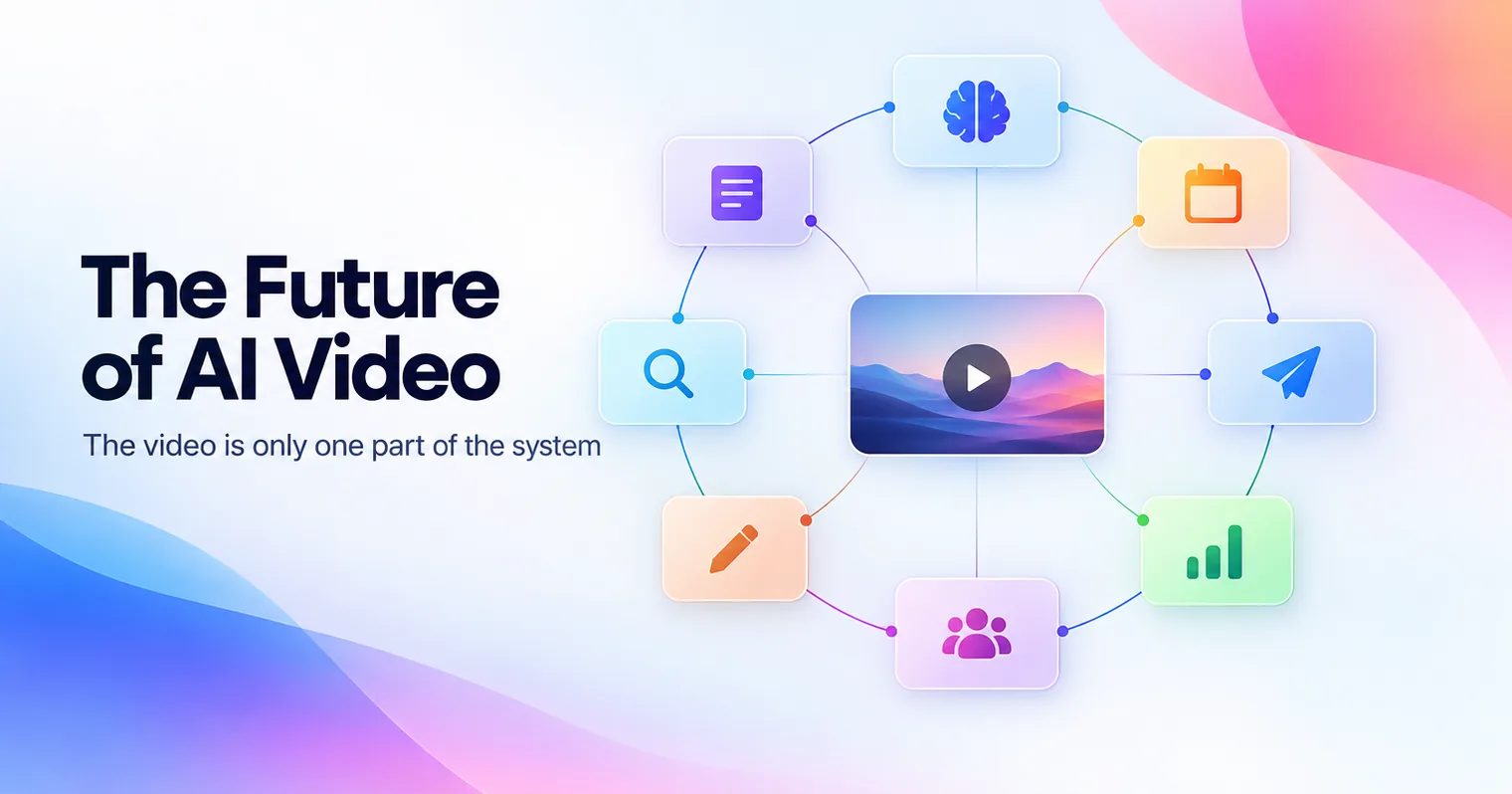
The future of AI video is not the ability to make a video. That part is getting cheaper every month, and soon almost any company will be able to make a polished product video from a prompt. In this essay I argue that the value moves to everything around the video. That means deciding what to make, keeping it on brand, keeping it current, putting it in the right place and learning from how it performs.
- Good-looking video will become the baseline, so quality alone stops being an advantage.
- The hard question becomes which content a product needs, and when it needs to change.
- The winners will run the whole content loop, not just the step that renders the video.
Why making the video is becoming a commodity
Making the video is becoming a commodity because AI models are improving fast at every part of production. Motion graphics, voiceovers, editing, animation, avatars and screen recordings are all getting cheaper and easier to generate. A year ago, a tool that produced a good-looking product video automatically felt like a major advantage. Soon it will just be the baseline that every team expects.
That changes what a product like ours needs to become. I am the founder of GuideClarity, the platform behind this blog. I do not think its long-term value can simply be "AI that makes videos." When the video itself is a commodity, what matters is everything around it.
The ten shifts below are how I see that playing out for SaaS teams. They are a point of view, not a forecast with numbers attached. Some describe where products like ours are heading rather than what any tool does today, and I say so where that applies.
1. SaaS content demand will grow fast
SaaS content demand will grow because software is getting much easier to build. AI coding tools and vibe coding let small teams launch products that once needed large engineering groups. More SaaS products means more features, more releases, more documentation, more onboarding, more tutorials and more product marketing. Every one of those needs content, and much of that content works best as video.
So the number of videos a company needs will rise, even as the cost of each video falls. That is a huge opportunity. It is also a trap for any team that still treats each video as a small production project.
If a team ships every week, it cannot brief, script, record and edit a video for every change by hand. The volume alone forces a different way of working.
2. Good-looking video is becoming the baseline
Good-looking product video is becoming the baseline because the skills it used to require are being automated. Today a polished product video still needs the right tools, editing skills or a specialized team. That barrier is disappearing. Soon almost any company will be able to generate a decent product video from a prompt, the same way anyone can now make a clean landing page.
When that happens, video quality alone stops being a moat. Good-looking becomes normal. Viewers will stop being impressed by smooth motion and a nice voice, the same way nobody is impressed by a website that loads.
The new AI explainer videos already show this. They look professional, and that is exactly why looking professional no longer sets a company apart.
3. The real question is what to create
The real question for SaaS teams becomes what content to create, not how to create it. Most video tools still start with a blank prompt that asks, "What video would you like to make?" A better tool should be able to answer that question for you, and say, "These are the videos your product needs." That is a much more valuable starting point.
To do that, a tool has to understand the product, its features, the help center, the website, the changelog, customer questions and the content that already exists. Then it can find the gaps on its own. A few examples show how that would work.
- A new feature ships, so the product needs an announcement video.
- A help article gets heavy traffic, so it deserves a tutorial video.
- Customers keep asking the same question, so an explainer would save support time.
- A competitor comparison is getting search traffic, so a comparison video is worth making.
- The product interface changes, so the affected tutorials need an update.
That is far more useful than one more way to generate a clip.
4. Creation is only one step in the content loop
Video creation is only one step in a larger content loop, and the loop is where the value sits. Today most tools cover a single step, a prompt in and a video out. The real workflow for a SaaS team has six steps that repeat with every release. A product content system should eventually own the whole loop, not just the rendering in the middle.
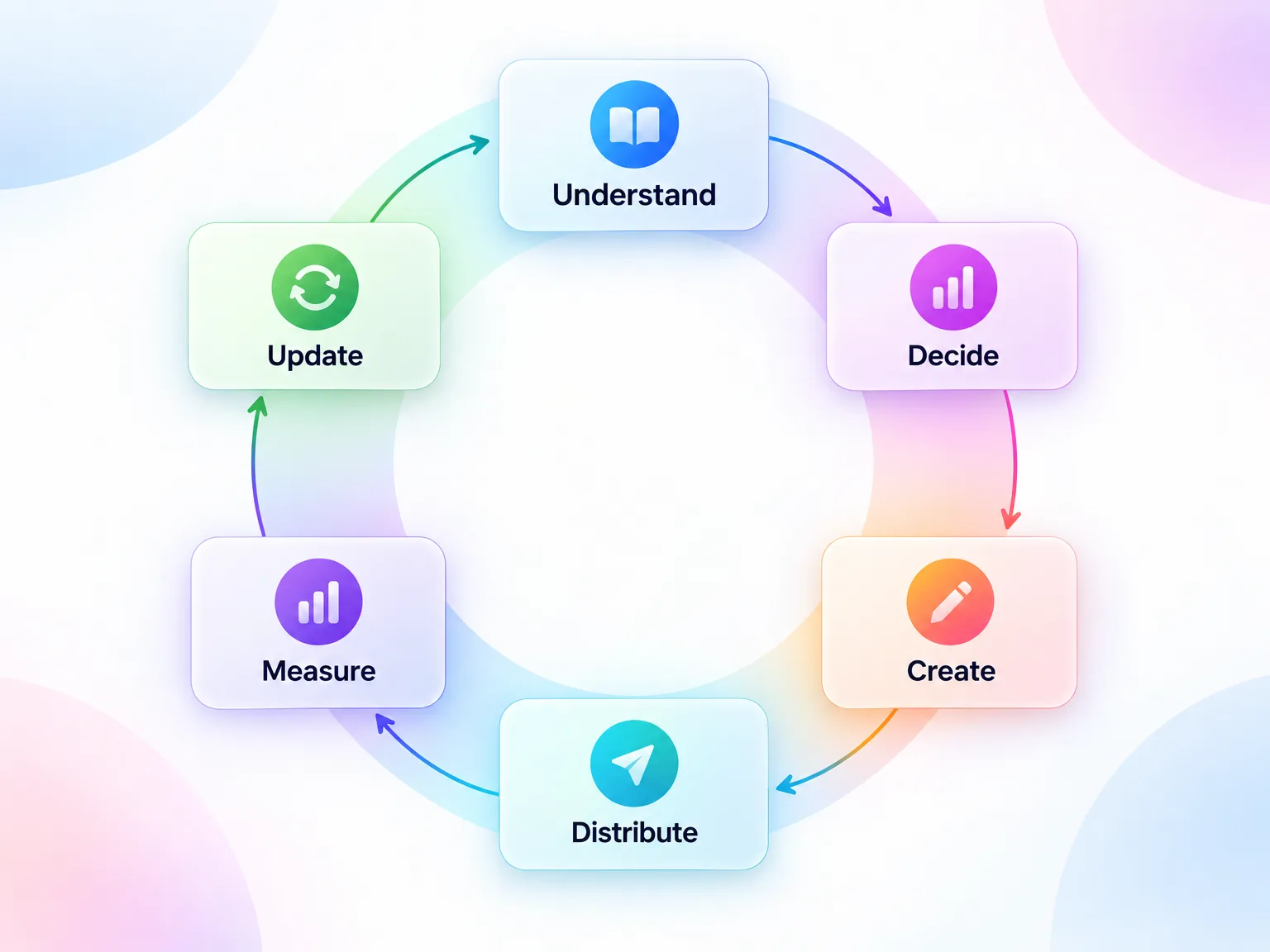
- Understand. Learn the product, the users and what changed.
- Decide. Choose which content should exist and who it is for.
- Create. Produce the video and the other assets.
- Distribute. Publish each version where its audience is.
- Measure. See what people watch, skip and act on.
- Update. Refresh what is outdated and improve what underperforms.
Owning the loop means helping a company answer questions that a video generator never touches. Which videos should we make? Who is each one for, and what format fits? Where should it be published, and when does it need an update? Which videos are outdated, which ones perform well, and which content should be repurposed?
5. Brand consistency becomes more valuable
Brand consistency becomes more valuable because cheap video means a lot more video. When everyone can generate videos, companies will generate many of them, often with different tools and different people. Everything starts to look inconsistent. You get different styles, different voices, different animations, different terminology and different quality, all under one brand name.
A product content system should understand a company's visual language and apply it every time. That language includes brand colors, typography, motion style, voice, narration style, terminology, layouts, intros, transitions and calls to action.
The goal is simple. Instead of generating "an AI video," the system should generate your company's video. Viewers should recognize it as yours before the logo appears.
6. Product understanding could become the real moat
Product understanding could become the real moat for AI video tools, more than the video generation itself. The most interesting part of what we are building at GuideClarity may be the AI agent that understands the software. A tool that knows how a product works can make good decisions about content. A tool that only renders video cannot.
That understanding covers what the product does, how each feature works and how users move through it. It also covers what changed between releases, which workflows matter and which audiences use those workflows. Once a system knows all of that, video becomes just one possible output.
The same understanding can produce video tutorials, help articles, social clips, release videos, product demos, documentation, comparison content and onboarding content. One understanding layer feeds many outputs. That is the idea behind a content repurposing workflow, taken one level deeper. The source is no longer a single recording. It is the product itself.
7. Keeping product content current could matter most
Keeping product content current could be the biggest problem a product content system solves. SaaS teams create tutorials, and then the product changes. Three months later the screenshots are wrong, the buttons have moved and the workflows are different. Half the videos are quietly outdated, and nobody knows which ones until a customer complains or a support ticket arrives.
Our own modeled estimate puts the size of this problem in view. In our SaaS video documentation report, about 35 percent of dated video-covered help articles were updated at least 90 days after their video was made. That figure comes from a market model, not a crawl, so treat it as an estimate of the problem's size.
A better system should be able to say, "This product changed, and these 14 videos are affected." Eventually it should be able to say, "I have already regenerated them." That is a very different job from the one a normal video generation tool does.
8. Distribution matters almost as much as creation
Distribution matters almost as much as creation, because a video only helps when the right person sees it. Creating the video is not the goal. Getting it in front of the user who needs it is. So a product content system has to think beyond exporting an MP4 and leaving the rest to someone else.
A single piece of product content might belong in many places:
- YouTube and Google search
- the help center and the knowledge base
- a product page
- an onboarding flow or an email
- inside the product itself
Each place needs its own version. A help center tutorial, a 30 second LinkedIn clip and an in-app walkthrough can come from the same source but should not be the same file. The SaaS onboarding video playbook shows how much placement alone changes what a video needs to do.
9. Performance should feed back into the next version
Video performance should feed back into the next version, so content improves on its own instead of going stale. Most tools end the job with "Your video is ready." A product content system should keep going after publishing. It should watch how each video performs and turn those signals into the brief for the next version.
The feedback could sound like this. "Users drop off at 38 seconds." "This tutorial gets far more search traffic than your others." "People replay this section again and again." "The 60 second version converts better than the 3 minute version."
Then the system should use those signals when it generates the next version. That turns a pile of videos into a feedback loop that gets better with every release.
10. The future of AI video looks like the history of websites
The future of AI video will probably look like the history of websites. AI video generation will become infrastructure, the same way website building did. In the 1990s, building a website was highly specialized work. Then came content management systems, then templates, then Webflow, then AI website builders. Today almost anyone can make a website.
Yet companies still pay a lot for website strategy, brand, conversion, architecture and great execution. Making the page became easy. Making the right page, in the right place, for the right person, stayed hard and valuable.
I think video will follow the same path. The interesting companies will not win because they can generate a video. They will win because they understand which content should exist, how it should look, where it should go, when it should change and whether it is working.
Where GuideClarity is today and where it is going
GuideClarity today makes finished product videos on its own, and the direction is a full product content system. You tell it what you want to show. GuideClarity opens your product, works out the workflow, records the right screens and writes the script. It adds the voiceover, captions, zooms, motion graphics and your brand style, then hands you a finished video. From a shipped feature, it can also produce a launch kit with shorts, a blog post and social posts.
That already covers the understand and create steps, and it keeps every video in your brand style. The rest of this essay describes where I want to take it next. That means deciding what content a product needs, re-recording outdated videos when the interface changes, publishing each version in the right place, and learning from performance. Those are goals, not features you can switch on today.
The direction is not AI that creates videos. It is AI that understands your product and keeps creating the content it needs. In the end, that looks like an autonomous product content team. That feels like a much bigger company to build, and a much more useful one for the teams who use it.
Key Takeaways
- AI video generation is turning into a commodity, so polished video alone will not set a company apart.
- SaaS teams will need far more content as software gets easier to build and ship.
- The valuable question is which content a product needs, not how to render one video.
- Brand consistency, freshness, distribution and performance feedback become the real work.
- Product understanding is the layer that can feed every output, from tutorials to release videos.
Frequently Asked Questions
What is the future of AI video?
The future of AI video is that making a video becomes cheap and ordinary. Models already handle motion graphics, voiceovers, editing, avatars and screen recordings. As that spreads, the value moves to deciding what to make, keeping it on brand and current, publishing it in the right places and improving it from real viewer data.
Will AI video generation become a commodity?
AI video generation is likely to become a commodity, much like website building did. When almost any company can create a polished video from a prompt, quality stops being a differentiator. The tools that matter will be the ones that understand the product and run the whole content process, not only the rendering step.
What matters when everyone can make a good-looking video?
When everyone can make a good-looking video, the things that matter are relevance, consistency and freshness. Teams need the right video for each feature and question, in their own brand style, kept current as the product changes, and placed where each audience will actually see it. Performance data then shows what to improve next.
How do SaaS teams keep product videos up to date?
Most SaaS teams keep product videos up to date by hand today. Someone notices a changed screen, re-records the workflow, edits it and uploads a new file. That does not scale as release speed grows. A product content system should detect which videos a product change affects and regenerate them automatically.
What does GuideClarity do today?
GuideClarity makes finished product videos from a simple request. It opens the product, works out the workflow, records the screens and writes the script, then adds voiceover, captions, zooms, motion graphics and brand style. Re-recording videos after interface changes, and the wider content loop in this essay, are what the company is building next.