
These product demo statistics show a clear gap between asking for a demo and showing one. Every number in this report comes from a published third-party study, and each one is linked to its source. We compiled them from 8 public studies released in 2026 and checked each figure on its source page.
- Most B2B SaaS websites lead with a sales demo request, and few let buyers explore the product on their own.
- Product demo video on SaaS homepages is rare, even though homepage video is common.
- Many product videos show the interface but never show the product producing a result.
Key findings from 2026 product demo research
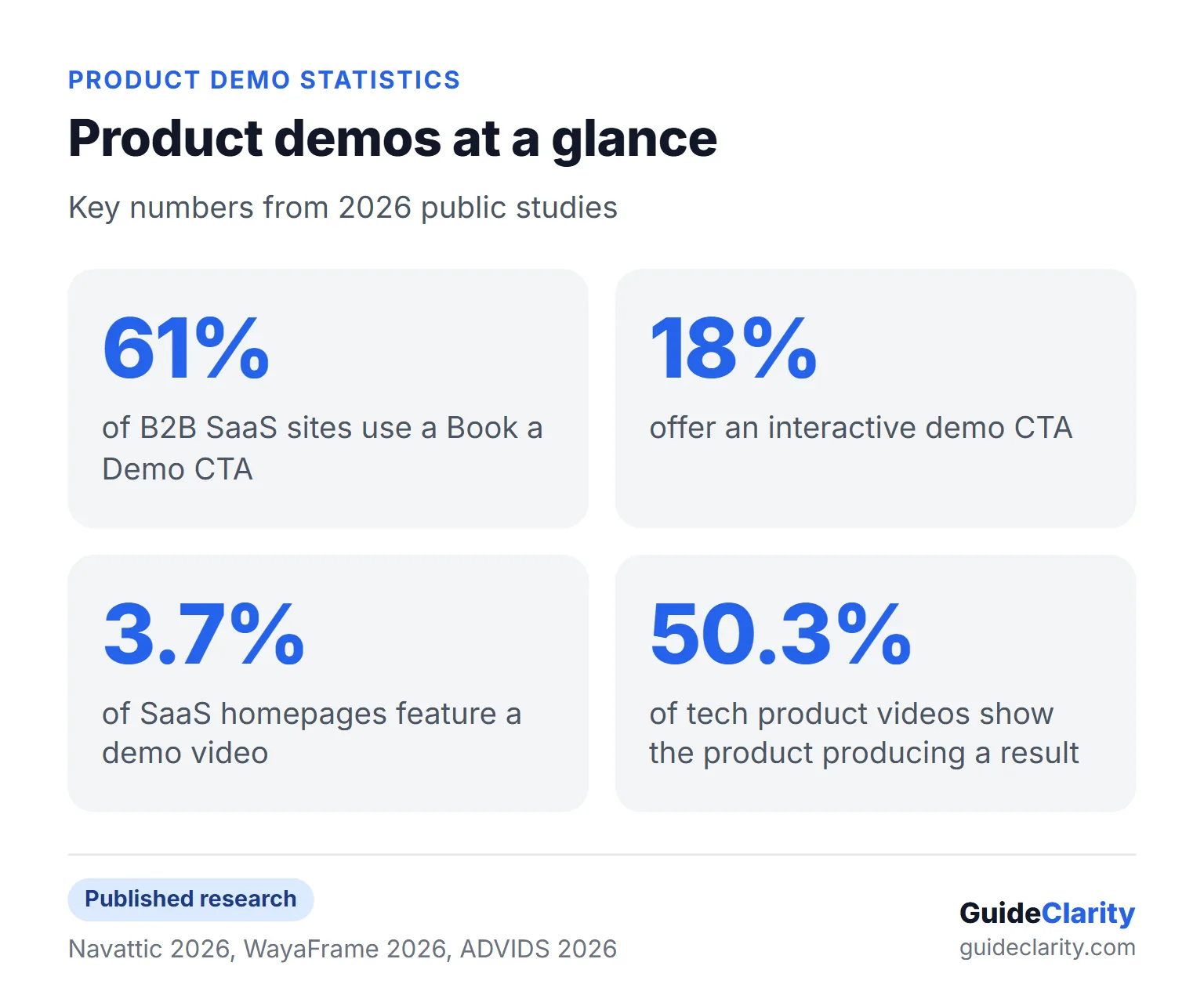
The key product demo findings of 2026 point one way. SaaS companies use the word demo far more than they show the product. The list below gives each finding with its study and sample. The studies use different samples and definitions, so treat each number on its own and do not subtract one from another.
- 61% of about 5,000 B2B SaaS websites use Book a Demo, and 18% offer an interactive demo, according to Navattic's 2026 report.
- Only 3.7% of 1,536 SaaS homepages feature a product demo video, while 32.3% use homepage video, according to WayaFrame.
- Just 22% of sales-led startups show a product screenshot in the hero, against 57% of self-serve startups, in MKT1's study of 100 startups.
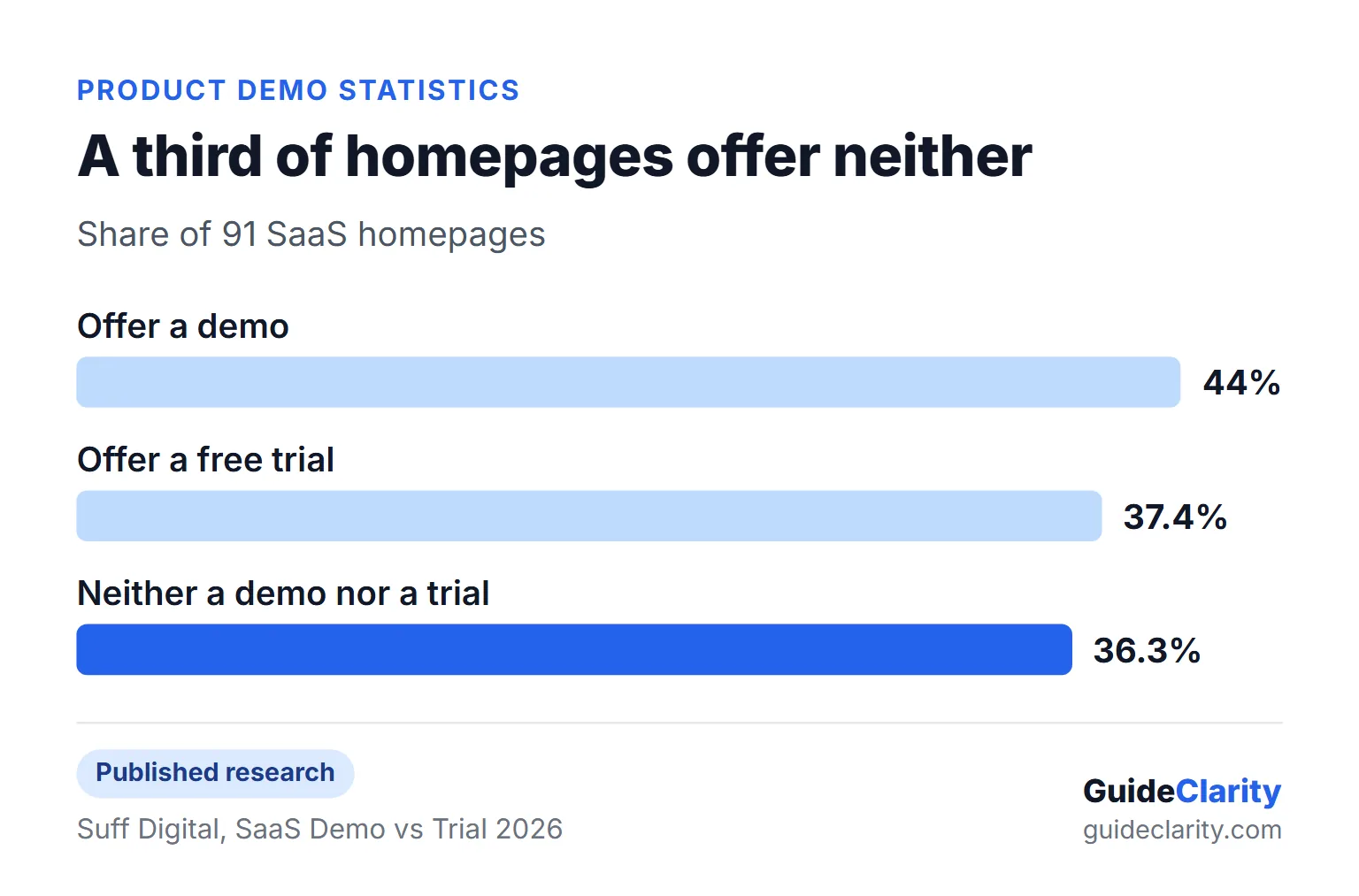
- 36.3% of 91 SaaS homepages offer neither a demo nor a free trial, according to Suff Digital.
- The median enterprise SaaS explainer runs 1:14, and 81.1% run two minutes or less, in an ADVIDS study of 106 videos.
- Only 50.3% of 149 tech product videos show the product producing a result, in an ADVIDS study of aha moments.
- Only 34.9% of 106 enterprise SaaS explainers end with a URL or an ask, according to ADVIDS.
- Burned-in captions appear in 10.4% of those 106 explainers, even though 69.8% use voiceover, according to ADVIDS.
What counts as a product demo?
A product demo is anything that lets a buyer see the software do its job. In these studies that covers three formats. A demo video is a prerecorded video whose main purpose is to show the product interface, a workflow or an output. An interactive demo is a clickable, guided copy of the product. A sales demo is a live call that a buyer has to request and book.
Two more terms matter for the numbers below. A self-service demo is any demo a visitor can see without speaking to sales first. A gated demo asks for an email or an account before it plays. Brand films, testimonials and webinar recordings are not product demos, even when they sit on a homepage.
How many SaaS websites ask buyers to book a demo?
Most SaaS websites still ask buyers to book a demo. Navattic's 2026 report tracks about 5,000 B2B SaaS websites. It reports that 61% use a Book a Demo CTA, 22% use a Try for Free CTA and 18% offer an interactive demo CTA. A sales conversation is still the default first step.
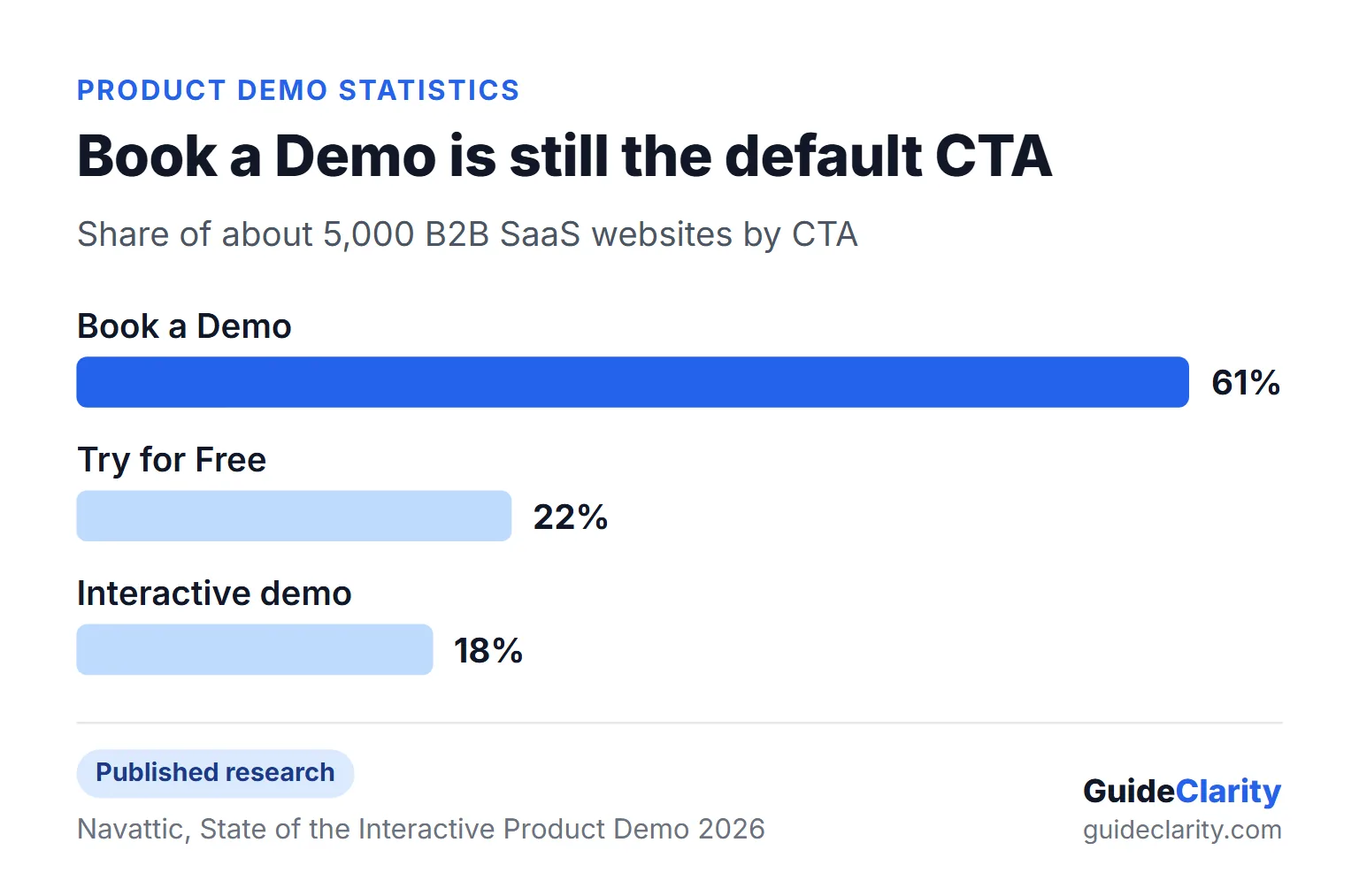
Interactive demos have reached real adoption, but they have not replaced the sales demo. Navattic also looks at the best performing interactive demos. It reports that 66% of top demos are ungated, and when a gate is used, 75% ask for just one field. The best self-service demos remove friction instead of adding it.
For a buyer, the gap is simple. On most SaaS sites the product sits behind a calendar invite. Our comparison of interactive demo tools covers the software teams use to change that.
How many SaaS homepages show a product demo video?
Few SaaS homepages show a product demo video. WayaFrame's 2027 State of SaaS Video Report studied 1,536 SaaS websites sourced from G2. It reports that 32.3% use homepage video and 30.5% use autoplay video, GIFs or both. Yet only 3.7% feature a product demo video on the homepage.
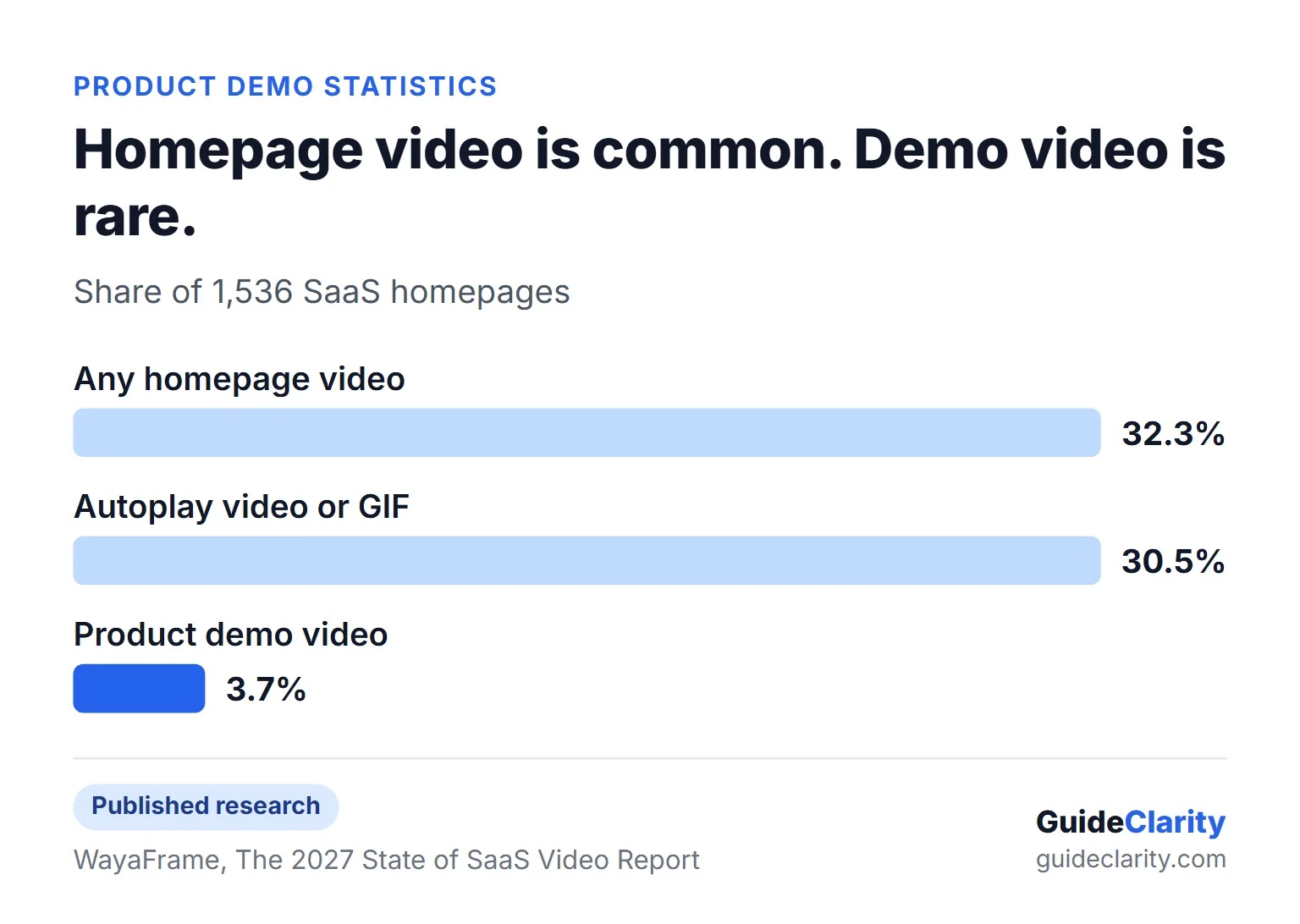
The gap shows up inside the video group too. Among the 496 companies with homepage video, only 55 featured a demo video, about 11.1% of that group, according to WayaFrame. Most homepage video is motion, brand or atmosphere rather than a look at the product working.
Which SaaS categories use product demo video most?
Project management software uses product demo video most among the categories WayaFrame studied, at 8.0% of homepages. Accounting software uses the most homepage video overall, at 44.9%, but none of its homepages in the sample featured a demo video. Video conferencing, marketing automation and e-commerce platforms all sit near 2% or below.
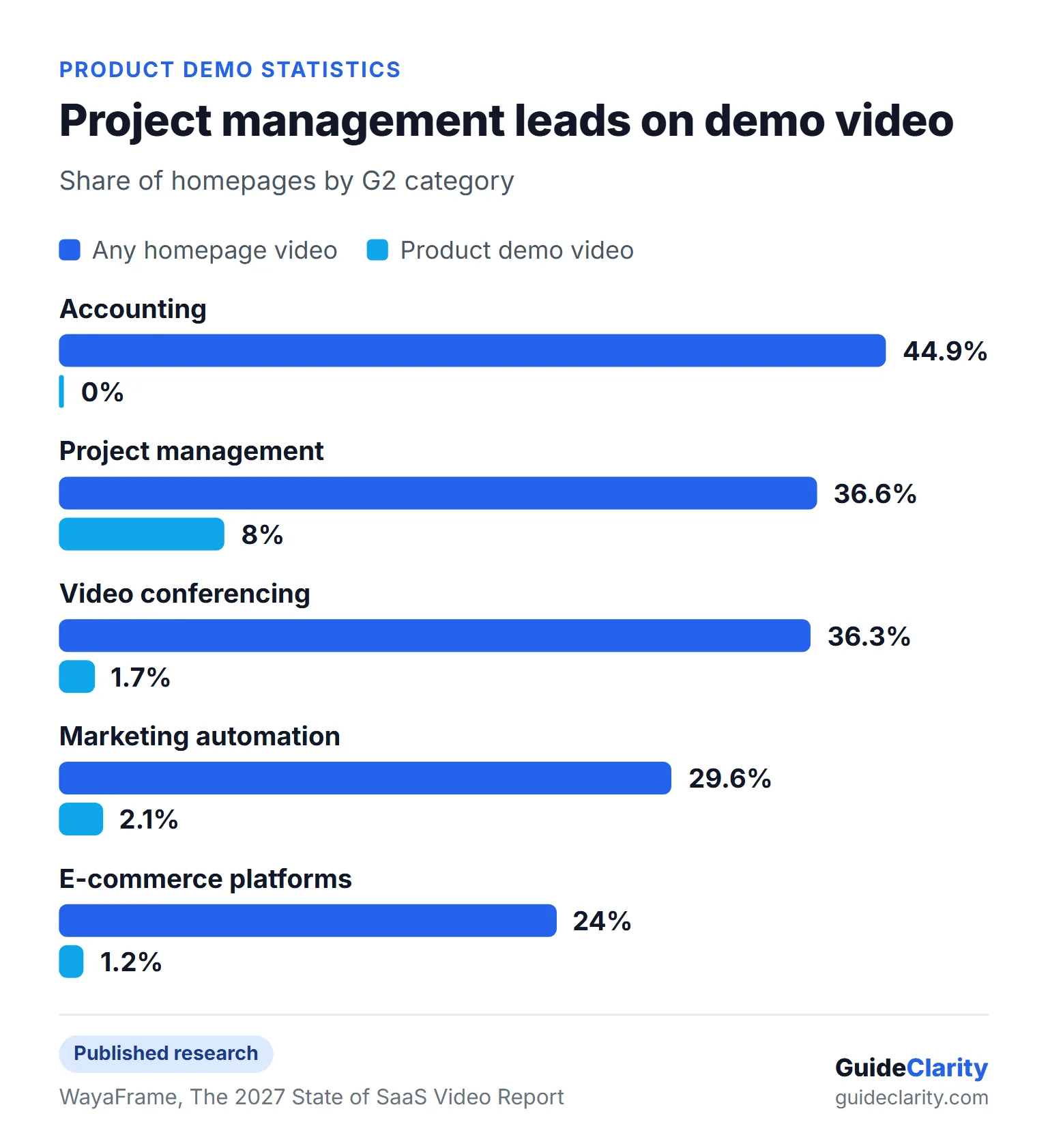
The pattern suggests that video budgets go to brand storytelling first. Categories where the workflow is the selling point, like project management, are the ones most likely to show it. Our guide to which SaaS videos are worth the money shows where else that budget can go.
Do SaaS companies show the product before a sales call?
Many SaaS companies do not show the product before a sales call, and the gap tracks their sales motion. In MKT1's 2026 study of 100 high-growth B2B startups, only 22% of sales-led companies show a product screenshot in the homepage hero. That rises to 37% for hybrid companies and 57% for self-serve companies.
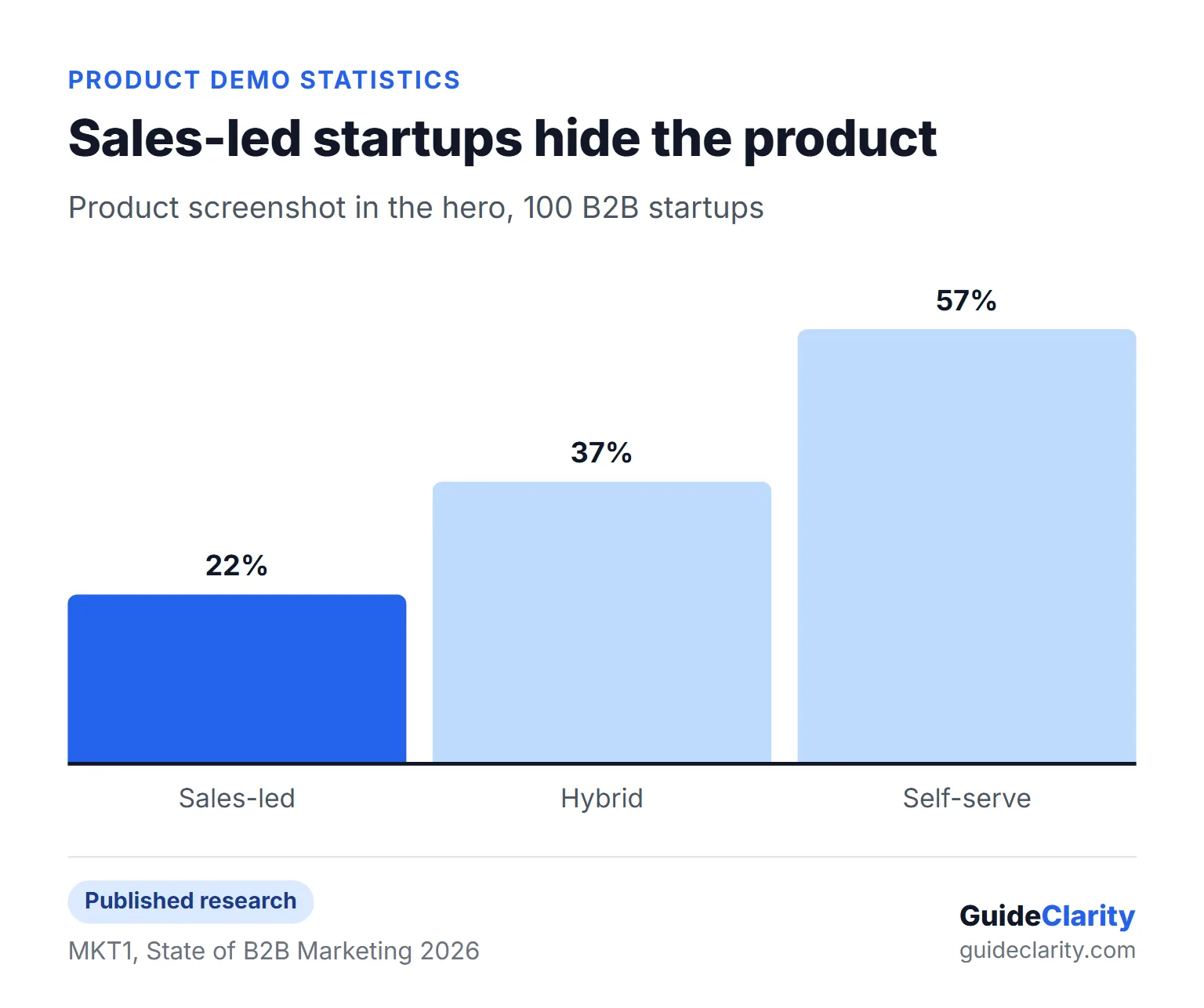
The more a company relies on sales, the less it shows the product up front. That makes sense for complex deals. It also means the buyers who research most on their own get the least to look at.
Demo or free trial on SaaS homepages?
SaaS homepages split between demos and free trials, and many offer neither. Suff Digital's 2026 study of 91 SaaS homepages shows that 44% offer a demo and 37.4% offer a free trial. Another 36.3% offer neither a demo nor a free trial, so the visitor gets no clear way to try or see the product.
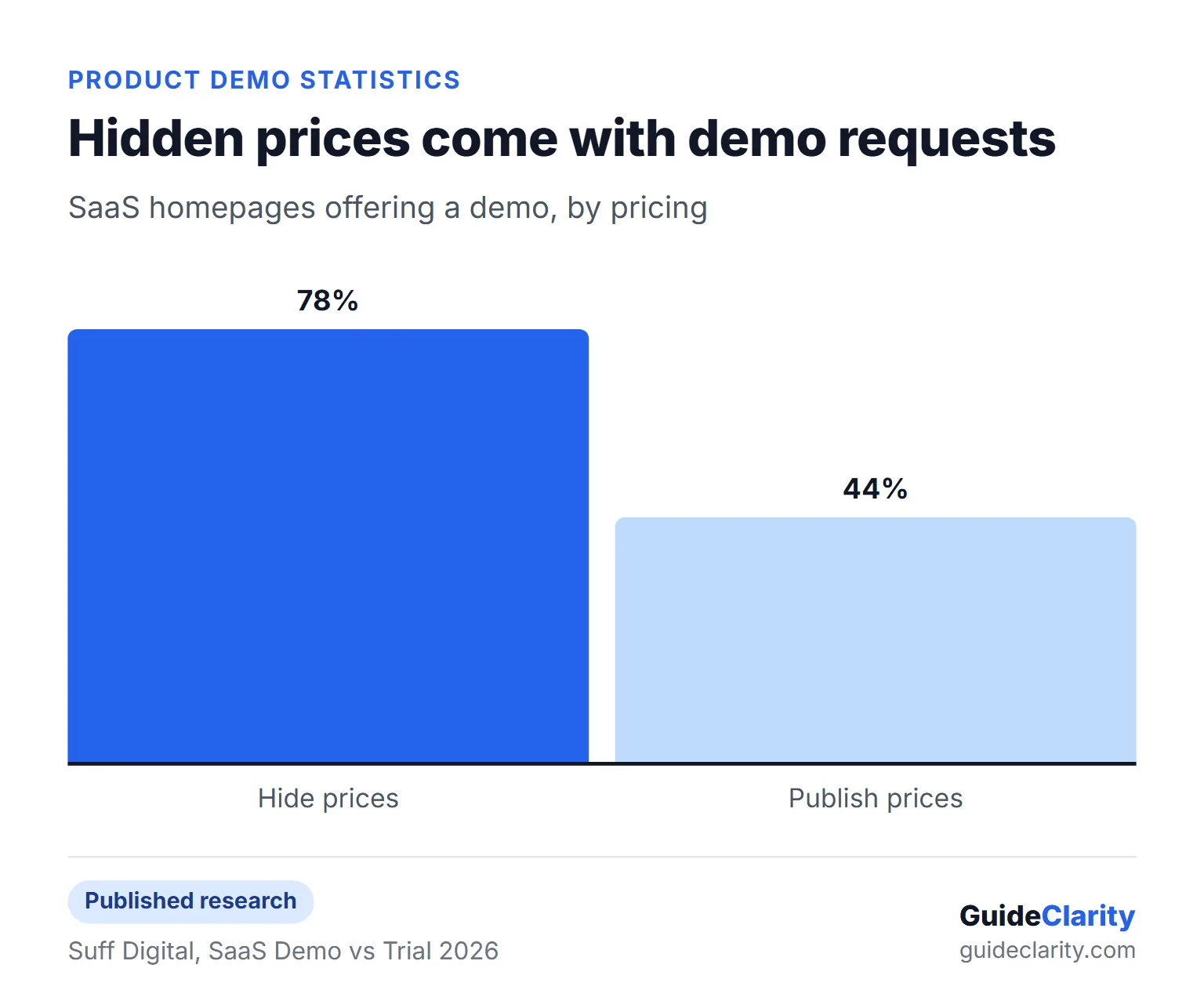
Pricing changes the picture. Suff Digital reports that 78% of SaaS companies that hide their prices offer a demo on the homepage, against 44% of those that publish prices. Hidden pricing and a demo request usually travel together.
How long should a product demo video be?
A product demo video should usually run between one and two minutes, based on what polished SaaS videos actually do. In an ADVIDS study of 106 enterprise SaaS explainers, the median runs 1:14 and the middle half spans 0:51 to 1:44. 86 of 106, or 81.1%, run two minutes or less.
A second ADVIDS study of 149 tech product videos lands in the same place, with a median runtime of 1:11. Voice changes the length. In the enterprise set, voiced videos run a median 1:21 and speak a median 158 words, while music-only videos run a median 0:59.
These are lengths for marketing and explainer videos, not full sales walkthroughs. Our guide on making a product demo video that converts covers how to plan one to fit this range.
Voiceover, on-screen text and captions in product videos
Most polished product videos use voiceover and on-screen text, but few burn captions into the picture. In the ADVIDS enterprise study, 69.8% of 106 explainers use voiceover and 91.5% put words on screen in at least half their segments. Only 10.4% burn captions into the picture.
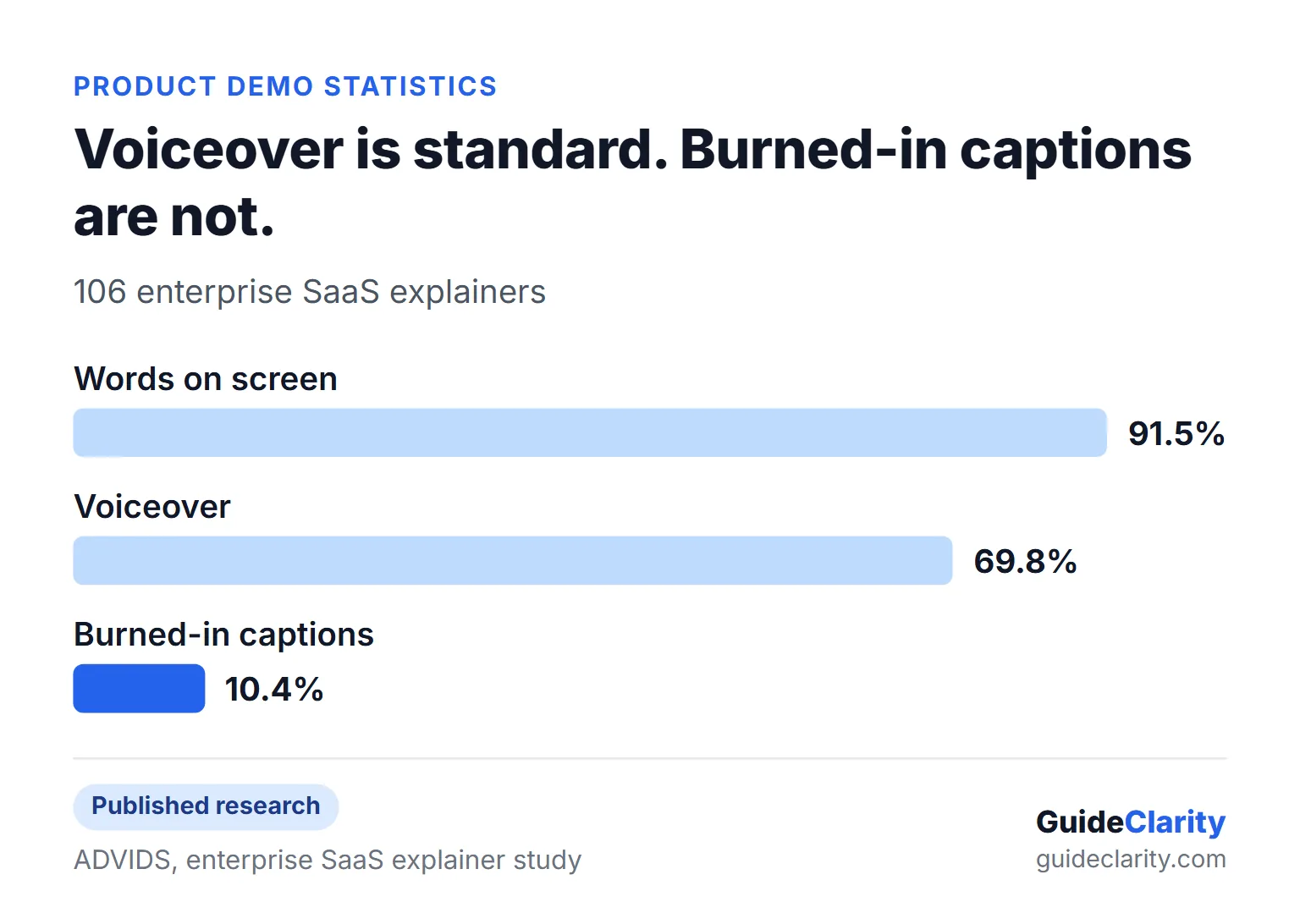
Tech product ads show the same pattern. In an ADVIDS study of 124 tech product ads, burned-in captions appear in 9 of 124, or 7.3%. Captions still matter to video teams. Wistia's 2026 State of Video report says 90% of teams are taking steps to make videos accessible. Captions are the most common place they start.
The difference is where the captions live. Player captions can be switched on. Burned-in captions play on silent autoplay feeds, where most viewers never turn the sound on.
Do product videos show the product producing a result?
Only about half of product videos show the product producing a result. In an ADVIDS study of 149 tech product videos, 86.6% show the product on screen. Yet only 75 of 149, or 50.3%, show it producing a visible result. Another 54 show the product and never show it produce anything, and 20 never show the product at all.
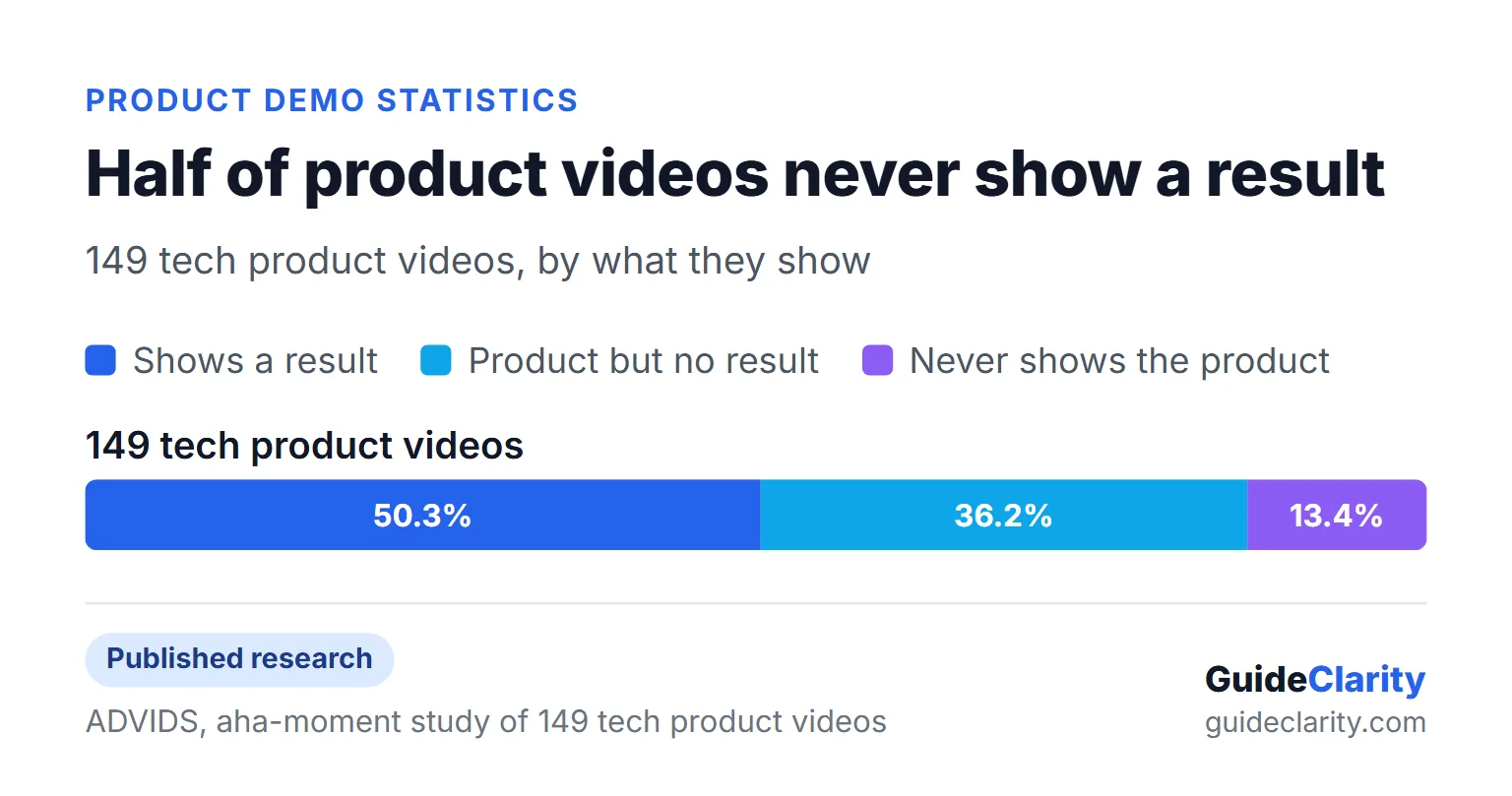
The product itself arrives fast, at a median 0:12. The first result arrives later, at a median 0:34. ADVIDS also flags 32 of its codes as close calls. The true result count could run from 54 to 86 videos, or 36.2% to 57.7%.
Showing the interface is not the same as showing value. A video that ends before the product finishes the job asks the viewer to imagine the payoff.
How product videos end
Most product videos end on the company name instead of a next step. In the ADVIDS enterprise study, 93.4% of 106 explainers end with the company or product name on screen. Only 34.9% end with a URL or an ask, so 65.1% close without telling the viewer what to do next.
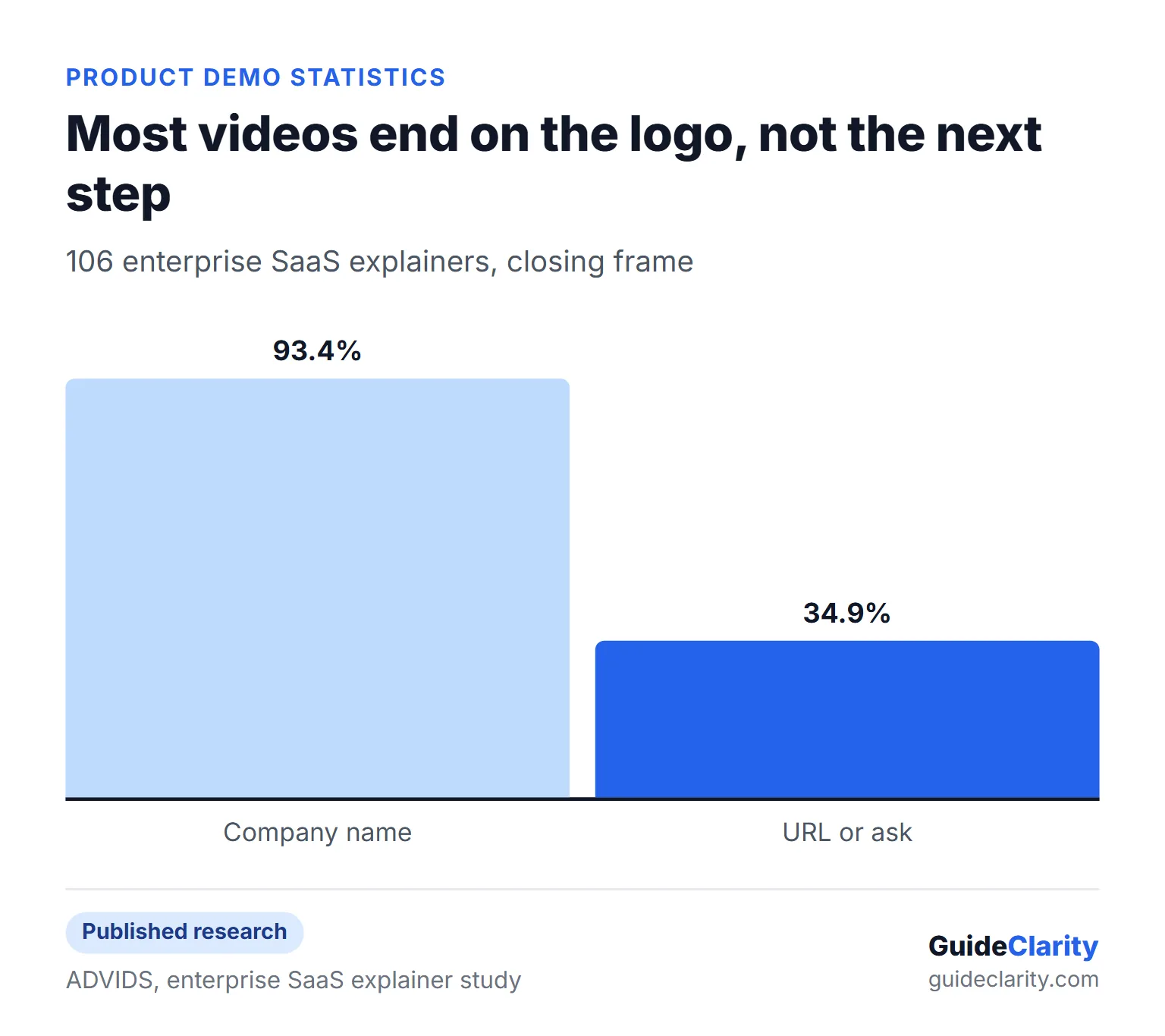
The other two ADVIDS studies agree. In the study of 149 tech product videos, only 18.1% put an ask on the closing frame. In the study of 124 tech ads, 20.2% put a URL or an ask in the closing segment. Many product videos work as brand content rather than as a step toward a trial or a demo.
The demo maturity ladder
The demo maturity ladder is a simple way to place any SaaS website on the path from hidden product to proven value. We propose it as a framework, not as a measurement. It has five levels, and each level adds one thing a buyer can see without a sales call. The studies above suggest most SaaS sites sit on the lower rungs.
| Level | What a buyer sees | Typical signal |
|---|---|---|
| 0. Hidden product | No product at all | Text, illustrations and a Book a Demo button |
| 1. Product visual | A static look at the interface | A screenshot or dashboard image |
| 2. Product motion | The interface moving | A loop, GIF or autoplay clip |
| 3. Self-service demo | A demo they can watch or click through | A demo video or interactive tour |
| 4. Outcome demo | The product finishing a real job | A completed workflow with a clear next step |
The ladder turns the statistics into a question any team can answer about its own site. Which rung are we on, and what would it take to climb one more?
What the statistics mean for SaaS teams
For SaaS teams, these statistics point to an easy way to stand out. Most competitors ask for a call before they show anything, so a clear self-service demo is still rare. The bar is not a polished brand film. It is a short video or tour that shows the product finishing a job and then tells the viewer what to do next.
- Show the product above the fold, even as a single real screenshot.
- Add one self-service demo for your most valuable workflow, before the Book a Demo button.
- Keep the demo video between one and two minutes, and get to the product in the first few seconds.
- Show the result, not just the screens. End on the outcome the buyer cares about.
- Close with a clear next step, such as a trial link or a booking link.
- Burn in captions for any video that will autoplay without sound.
Making those videos used to take a production cycle per feature. GuideClarity, the platform behind this blog, is an AI video agent. It opens your product, records the workflow and adds the script, voiceover, captions and your brand style. That makes a self-service demo for every key feature realistic for small teams.
How this report was compiled
The product demo statistics in this report come from 8 public studies published in 2026. We did not collect any of this data. Each figure was checked on its source page on October 6, 2026, and every number in the article links to the study it comes from. Figures that could not be found on a source page were left out.
| Study | Publisher | Sample |
|---|---|---|
| State of the Interactive Product Demo 2026 | Navattic | About 5,000 B2B SaaS websites |
| The 2027 State of SaaS Video Report | WayaFrame | 1,536 SaaS websites from G2 |
| State of B2B Marketing 2026 | MKT1 | 100 high-growth B2B startups |
| SaaS Demo vs Trial 2026 | Suff Digital | 91 SaaS homepages |
| Enterprise SaaS explainer study | ADVIDS | 106 videos from 88 companies |
| Aha moment study | ADVIDS | 149 videos from 124 companies |
| Silent autoplay ad study | ADVIDS | 124 tech product ads |
| State of Video 2026 | Wistia | 900+ professionals |
Where a study gives counts, the percentage shown is the count divided by the stated base, rounded to one decimal. The demo maturity ladder is an original framework from this report and contains no measured data.
Limitations of these product demo statistics
The main limitation of these statistics is that they come from different studies. Each one uses its own sample, its own definitions and its own collection date. A share from one sample and a share from another cannot be combined into one funnel. Read each number with its source and base.
The samples also lean in different directions. Navattic and WayaFrame cover large website samples. MKT1 and Suff Digital use smaller curated sets, and the ADVIDS studies code published videos rather than whole websites. Several publishers sell demo or video services, which is common for research in this field. We plan a measured study of SaaS websites next, and it will report its own sample in full.
How to cite and use this data
You can quote any figure from this page or reuse any chart with a link back to this page. Please also credit the original study named under each chart, since that publisher collected the data. Each section heading on this page has its own anchor, so you can link straight to the statistic you cite.
Suggested citation. GuideClarity Research, Product Demo Statistics, 2026 benchmarks from 8 studies, guideclarity.com/blog/product-demo-statistics
To embed a chart, copy the code below and replace the image file name with the chart you want.
<a href="https://guideclarity.com/blog/product-demo-statistics"><img src="https://guideclarity.com/images/gc-blog/product-demo-statistics/saas-homepage-video-vs-demo-video.webp" alt="Only 3.7% of SaaS homepages feature a product demo video (WayaFrame)" width="1536"></a>
<p>Chart: <a href="https://guideclarity.com/blog/product-demo-statistics">GuideClarity Product Demo Statistics</a>. Data: WayaFrame.</p>
Full data tables
The full data tables below repeat every value plotted in this report, with the study each one comes from. Values keep the precision their source publishes. Percentages built from counts are rounded to one decimal. Use these tables when you need an exact figure, and cite the original study along with this page.
Product demos at a glance
| Value | |
|---|---|
| of B2B SaaS sites use a Book a Demo CTA | 61% |
| offer an interactive demo CTA | 18% |
| of SaaS homepages feature a demo video | 3.7% |
| of tech product videos show the product producing a result | 50.3% |
Book a Demo is still the default CTA
| Value | |
|---|---|
| Book a Demo | 61% |
| Try for Free | 22% |
| Interactive demo | 18% |
Homepage video is common. Demo video is rare.
| Value | |
|---|---|
| Any homepage video | 32.3% |
| Autoplay video or GIF | 30.5% |
| Product demo video | 3.7% |
Project management leads on demo video
| Any homepage video | Product demo video | |
|---|---|---|
| Accounting | 44.9% | 0% |
| Project management | 36.6% | 8% |
| Video conferencing | 36.3% | 1.7% |
| Marketing automation | 29.6% | 2.1% |
| E-commerce platforms | 24% | 1.2% |
Sales-led startups hide the product
| Value | |
|---|---|
| Sales-led | 22% |
| Hybrid | 37% |
| Self-serve | 57% |
A third of homepages offer neither
| Value | |
|---|---|
| Offer a demo | 44% |
| Offer a free trial | 37.4% |
| Neither a demo nor a trial | 36.3% |
Hidden prices come with demo requests
| Value | |
|---|---|
| Hide prices | 78% |
| Publish prices | 44% |
Half of product videos never show a result
| Shows a result | Product but no result | Never shows the product | |
|---|---|---|---|
| 149 tech product videos | 50.3% | 36.2% | 13.4% |
Voiceover is standard. Burned-in captions are not.
| Value | |
|---|---|
| Words on screen | 91.5% |
| Voiceover | 69.8% |
| Burned-in captions | 10.4% |
Most videos end on the logo, not the next step
| Value | |
|---|---|
| Company name | 93.4% |
| URL or ask | 34.9% |
Frequently Asked Questions
How long should a product demo video be?
Most polished SaaS product videos run between one and two minutes. An ADVIDS study of 106 enterprise SaaS explainers shows a median of 1:14, with the middle half between 0:51 and 1:44. Aim for the shortest video that still shows the product finishing a real job.
What share of SaaS websites use a Book a Demo button?
Navattic's 2026 report shows that 61% of about 5,000 B2B SaaS websites use a Book a Demo call to action. By comparison, 22% use Try for Free and 18% offer an interactive demo, so a sales conversation is still the most common first step.
How many SaaS homepages have a product demo video?
Very few. WayaFrame studied 1,536 SaaS websites. Only 3.7% feature a product demo video on the homepage, even though 32.3% use some kind of homepage video. Most homepage video shows brand or motion rather than the product working.
Is a demo or a free trial more common on SaaS homepages?
Demos are slightly more common. Suff Digital's 2026 study of 91 SaaS homepages shows that 44% offer a demo and 37.4% offer a free trial, while 36.3% offer neither. Companies that hide their prices are much more likely to push a demo.
Should product demo videos have captions?
Yes, especially for video that autoplays without sound. Burned-in captions are still rare, appearing in 10.4% of 106 enterprise SaaS explainers in an ADVIDS study. Wistia reports that 90% of video teams are taking steps toward accessibility, and captions are where most start.
Sources
- Navattic, State of the Interactive Product Demo 2026
- WayaFrame, The 2027 State of SaaS Video Report
- MKT1, State of B2B Marketing 2026
- Suff Digital, SaaS Demo vs Trial 2026
- ADVIDS, The 2026 Enterprise SaaS Video Swipe File
- ADVIDS, What 149 Tech Videos Reveal About Showcasing the Aha Moment
- ADVIDS, silent autoplay study of 124 tech ads
- Wistia, State of Video 2026